Design and Pilot Evaluation of a Mobile-First Gamified Android Application for Introductory Programming Education
Keywords:
Android learning application, gamification, mobile learning, programming education, self-regulated learning, system usabilityAbstract
I
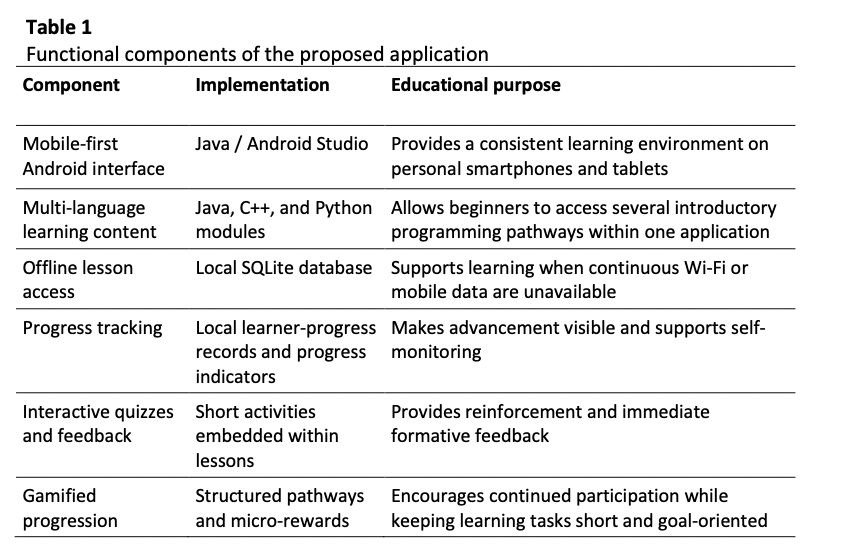
ntroductory programming can be difficult for novice learners when instruction depends on desktop-based tools, multiple software installations, and fragmented learning resources. This study designed and pilot-evaluated a mobile-first, gamified Android application that integrates introductory Java, C++, and Python learning in a lightweight, offline-capable environment. The application was developed iteratively using Agile methods, with Cognitive Load Theory and Self-Regulated Learning used as design principles rather than tested constructs. A four-week quantitative pilot involved 51 higher-education learners with predominantly no or limited programming experience. A structured questionnaire adapted from Technology Acceptance Model and System Usability Scale concepts was analysed using descriptive statistics and internal-consistency reliability. Results showed that 67% of participants primarily used smartphones or tablets for learning, 72% preferred interactive and visual learning, and 69% reported difficulty with traditional coding approaches. Interest in mobile-based coding was high (90% interested or very interested); 76% agreed that gamification increased motivation, 74% preferred curriculum-based learning, 71% preferred game- based activities over traditional quizzes, and 82% rated the system useful or very useful. Reported Cronbach's alpha values were 0.81 for usability and 0.84 for user satisfaction. The findings support the feasibility and perceived acceptability of a mobile-first programming-learning approach while avoiding causal claims that cannot be supported by the available pilot data.