Analysis of Airflow over a Circular Cylinder at Various Reynolds Numbers

Authors

  • Ahmad Alif Ashraf Azwan Faculty of Mechanical and Manufacturing Engineering, Universiti Tun Hussein Onn Malaysia, 86400 Parit Raja, Batu Pahat, Johor, Malaysia
  • Ahmad Danial Ahmad Junaidi Faculty of Mechanical and Manufacturing Engineering, Universiti Tun Hussein Onn Malaysia, 86400 Parit Raja, Batu Pahat, Johor, Malaysia
  • Ahmad Nadzim Jaafar Faculty of Mechanical and Manufacturing Engineering, Universiti Tun Hussein Onn Malaysia, 86400 Parit Raja, Batu Pahat, Johor, Malaysia
  • Aiman Akmal Mohd Farez Faculty of Mechanical and Manufacturing Engineering, Universiti Tun Hussein Onn Malaysia, 86400 Parit Raja, Batu Pahat, Johor, Malaysia
  • Shao Tang Eng Faculty of Mechanical and Manufacturing Engineering, Universiti Tun Hussein Onn Malaysia, 86400 Parit Raja, Batu Pahat, Johor, Malaysia

DOI:

https://doi.org/10.37934/sjotfe.8.1.19a

Keywords:

Airflow, circular cylinder, Reynold number, boundary layer, flow separation

Abstract

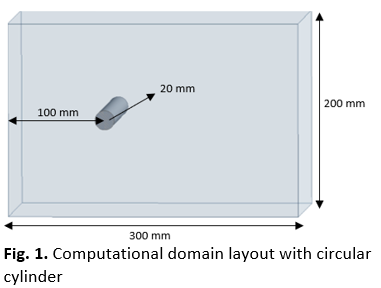
This study presents a Computational Fluid Dynamics (CFD) analysis of airflow over a circular cylinder to investigate external flow behaviour with various Reynolds numbers. The investigation aims to analyse the effects of Reynolds number on velocity distribution, pressure distribution, and streamline patterns around the cylinder. A three-dimensional circular cylinder with a diameter of 20 mm was modelled and simulated using ANSYS Fluent. The governing equations of continuity and momentum were solved using the Finite Volume Method (FVM), with air at 25 °C as the working fluid. Uniform inlet velocities of 3 m/s, 6 m/s, and 9 m/s were applied, corresponding to Reynolds numbers of approximately 3360, 6720, and 10080. The flow field was analysed using velocity contours, pressure distribution, and streamline visualisations. The results showed that increasing Reynolds number within the subcritical turbulent wake regime led to earlier flow separation, larger wake regions, and stronger pressure gradients around the cylinder. High pressure was consistently observed at the stagnation point, followed by a low-pressure wake downstream. Overall, the study demonstrates that CFD can effectively capture the fundamental characteristics of external flow over a circular cylinder and provides clear insight into Reynolds number effects on boundary layer development, flow separation, and wake formation.
Author Biographies

Ahmad Alif Ashraf Azwan, Faculty of Mechanical and Manufacturing Engineering, Universiti Tun Hussein Onn Malaysia, 86400 Parit Raja, Batu Pahat, Johor, Malaysia

dd220034@student.uthm.edu.my

Ahmad Danial Ahmad Junaidi, Faculty of Mechanical and Manufacturing Engineering, Universiti Tun Hussein Onn Malaysia, 86400 Parit Raja, Batu Pahat, Johor, Malaysia

dd220062@student.uthm.edu.my

Ahmad Nadzim Jaafar, Faculty of Mechanical and Manufacturing Engineering, Universiti Tun Hussein Onn Malaysia, 86400 Parit Raja, Batu Pahat, Johor, Malaysia

dd220052@student.uthm.edu.my

Aiman Akmal Mohd Farez, Faculty of Mechanical and Manufacturing Engineering, Universiti Tun Hussein Onn Malaysia, 86400 Parit Raja, Batu Pahat, Johor, Malaysia

dd200034@student.uthm.edu.my

Shao Tang Eng , Faculty of Mechanical and Manufacturing Engineering, Universiti Tun Hussein Onn Malaysia, 86400 Parit Raja, Batu Pahat, Johor, Malaysia

dd220060@student.uthm.edu.my

Downloads

Published

2026-04-02

Issue

Section

Articles