Analysis of Flow through a Sudden Expansion in a Pipe
DOI:
https://doi.org/10.37934/sjotfe.7.1.3851aKeywords:
Computational fluid dynamics, sudden expansion, turbulence models, RANS, flow separation, k-epsilon, k-omega SSTAbstract
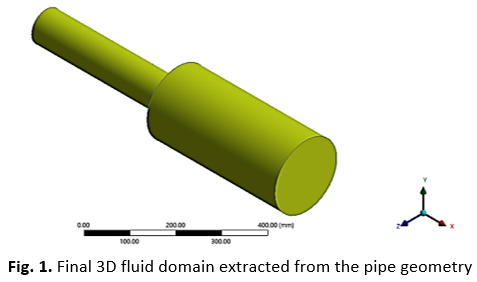
Internal flow through a sudden pipe expansion is a fundamental problem in engineering and serves as a classic benchmark for Computational Fluid Dynamics (CFD). The abrupt change in geometry causes complex flow separation and the formation of a turbulent recirculation zone, which is notably difficult to model accurately. The purpose of this research is to investigate these complex flow dynamics and critically evaluate the performance of three common Reynolds-Averaged Navier-Stokes (RANS) turbulence models. A 3D model of a sudden expansion pipe was created and simulated using ANSYS. A steady-state, incompressible simulation was run with an inlet velocity of 1 m/s. A Grid Independence Test (GIT) was first conducted by comparing five different mesh densities, which validated an optimal grid for the main study. This grid was then used to compare the Standard k-ε, Realizable k-ε, and k-ω SST turbulence models. The principal results show a significant discrepancy between the models. Qualitatively, the Standard k-ε model predicted a much shorter potential core and earlier flow reattachment compared to the other formulations. Quantitatively, it emerged as a distinct outlier, predicting a much faster centerline velocity decay and a significantly deeper, more aggressive pressure drop just after the expansion. In contrast, the Realizable k-ε and k-ω SST models were in strong agreement with each other, both predicting a more gradual and similar flow recovery. The major conclusion is that the Standard k-ε model has low perceived accuracy for this application due to its known limitations in separated flows. The Realizable k-ε model and k-ω SST models are demonstrated to be far more reliable and accurate choices for this benchmark case.