Internal Flow through a Y-Junction Manifold
DOI:
https://doi.org/10.37934/sjotfe.7.1.1016aKeywords:
Y-junction manifold, k-epsilon turbulence models, Computational Fluid Dynamics (CFD) simulationAbstract
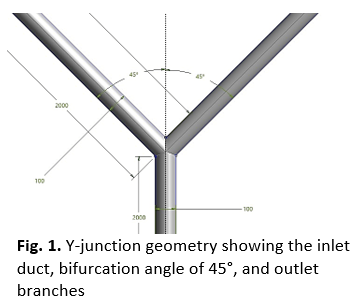
This study examines the flow behaviour inside Y-junction manifolds, which influences the performance of ventilation, piping, and fluid distribution systems. Due to complex shapes at the branching point, flow separation, pressure loss, and uneven velocity distribution often occur, posing challenges for accurate prediction. The research evaluates three popular k-ε turbulence model variants which were Standard, RNG, and Realizable using Computational Fluid Dynamics (CFD) to assess their effectiveness in predicting internal flow characteristics. A 3D Y-junction geometry was created and meshed with an unstructured grid, followed by a grid independence study to confirm numerical accuracy. The medium mesh shows a 3.73% deviation from the finer mesh, while the coarse mesh exhibits the largest difference at 6.28%, indicating that the finer mesh provides the most stable and mesh-independent solution. Water was the working fluid, with an inlet velocity of 1 m/s and zero-gauge pressure at the outlet. The SIMPLE algorithm solved the mass and momentum equations, running simulations for each turbulence model. Results show that all three turbulence models successfully captured the general flow pattern, including symmetric velocity splitting and a consistent pressure drop across the bifurcation. However, each model exhibited different levels of sensitivity to flow structures within the junction. The Realizable k-ε model produced the clearest velocity transitions and a more defined low-velocity region along the inner curvature, indicating better resolution of separation and secondary flow. The RNG k-ε model demonstrated improved sensitivity to strain and swirling effects near the branching zone, while the Standard model generated more diffused contours with weaker separation features. Overall, the findings highlight that turbulence model selection significantly influences the accuracy of predicted internal flow characteristics. Among the three models, the Realizable k-ε formulation provided the most consistent representation under the conditions studied, making it a suitable choice for analysing pressure behaviour and flow distribution in Y-junction manifold applications.