Aerodynamic Analysis of a Spoiler Using CFD
DOI:
https://doi.org/10.37934/sjotfe.10.1.1219aKeywords:
Aerodynamic, automotive spoiler, CFD, ANSYS Fluent, downforce, drag reduction, velocity contour, turbulence modelling, k-ω SST, external flowAbstract
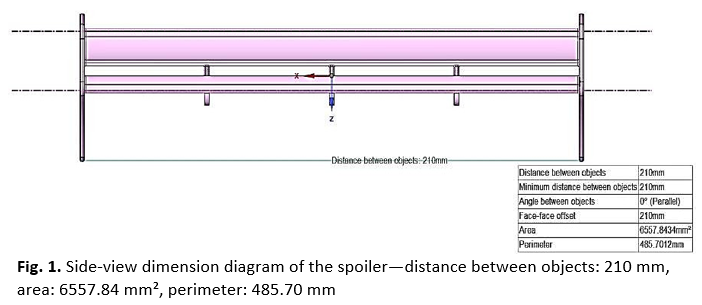
Automotive spoilers are aerodynamic devices designed to modify airflow around a vehicle's body, primarily to reduce drag and increase downforce, thereby improving vehicle stability and fuel efficiency at high speeds. This study presents a Computational Fluid Dynamics (CFD) investigation of the aerodynamic performance of a rear spoiler using ANSYS Fluent 2026 R1. The spoiler geometry, with a cross-sectional area of 6557.84 mm², a face-face offset of 210 mm, and a height of 70 mm, was modelled and simulated at three freestream inlet velocities: 20 m/s (72 km/h), 40 m/s (144 km/h), and 80 m/s (288 km/h). A polyhedral mesh was employed, with refined inflation layers around the spoiler surface to resolve boundary-layer effects accurately. The k-ω SST turbulence model was applied for all cases. Velocity contour and streamline results reveal that flow accelerates significantly over the upper surface of the spoiler at all speeds, generating a region of elevated velocity above the spoiler and a distinct low-velocity wake region downstream of the trailing edge. As inlet velocity increases from 20 m/s to 80 m/s, the maximum local velocity rises proportionally (approximately 32.49 m/s, 66.83 m/s, and 136.1 m/s, respectively), consistent with inviscid scaling. Recirculation structures and vortex formations in the spoiler wake become progressively more pronounced at 80 m/s. The results demonstrate that the spoiler geometry effectively redirects airflow, supporting downforce generation. This study validates the use of ANSYS Fluent for external automotive aerodynamics and provides a foundation for geometry optimisation of spoiler profiles.