Comparative Study of Internal Flow Dynamics Using CFD: Flow through Sudden Pipe Contraction and Expansion
DOI:
https://doi.org/10.37934/sjotfe.9.1.112aKeywords:
Sudden pipe, contraction, expansion, CFDAbstract
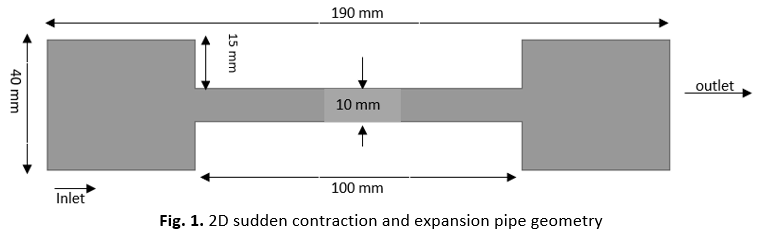
Sudden changes in cross-sectional area are encountered by many engineering systems with internal fluid flows, such as fluid distribution networks, control valves, and industrial nozzles. These abrupt geometric transitions lead to complex hydrodynamic phenomena, predominantly severe flow separation, the generation of recirculation vortices and large variations in localised static pressure. In order to optimise the system performance and to minimise the mechanical energy losses, the pressure drop across the geometric irregularities should be predicted accurately. Hence, the present work is aimed to numerically investigate the internal flow behaviour and quantify the exact pressure drop in a horizontal pipe with a sudden contraction followed immediately by a sudden expansion. A 2D axisymmetric computational domain was developed and the incompressible Navier-Stokes, continuity and energy conservation equations were solved using a finite-volume method discretisation approach. The working fluid was liquid water and the inlet velocity was uniform at 0.125 m/s at the upstream boundary. In order to ensure that the numerical predictions were mathematically stable and not influenced by the spatial discretisation, a rigorous grid independence test (GIT) was carried out comparing coarse (1234 elements), medium (4746 elements) and fine (18400 elements) mesh resolutions. The numerical results were quantitatively accurate in reproducing the expected localised flow acceleration at the contraction and the subsequent boundary layer separation at the expansion. The grid independence study showed stabilisation. The pressure drops were 200.28 Pa, 192.92 Pa and 198.24 Pa for coarse, medium and fine grids respectively. The 198.24 Pa value is a very accurate grid independent solution with less than 3% marginal deviation between the medium and fine meshes. Finally, the finite volume approach is validated in this study as a robust tool for predicting mechanical energy dissipation in variable area piping system.