Computational Modelling on Conjugate Heat Transfer in a Finned Pipe Unit
DOI:
https://doi.org/10.37934/sjotfe.9.1.1322aKeywords:
Conjugate, double-pipe, CFDAbstract
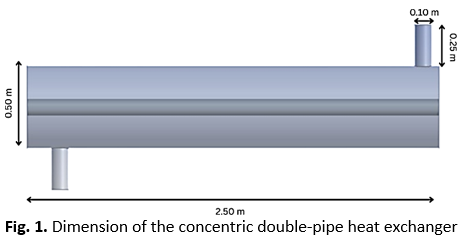
Double-pipe heat exchangers are fundamental thermal management devices that rely on conjugate heat transfer to exchange energy between fluids. While modern research extensively explores complex passive enhancements like finned surfaces to improve thermal efficiency, these modifications introduce significant pressure drops and obscure the fundamental physics of the heat exchange. Consequently, there is a critical need for high-fidelity, baseline numerical data that isolates the pure effects of varying flow regimes in unmodified pipes. This study aims to establish this baseline by systematically quantifying the isolated impact of fluid velocity on the conjugate heat transfer performance of a smooth double-pipe heat exchanger. A three-dimensional computational fluid dynamics (CFD) simulation was conducted to model the cooling of hot liquid ethylene using water as the coolant. A structured hexahedral mesh was utilized, achieving grid independence at 47,614 elements with a microscopic 0.005% outlet temperature variation after targeted refinement of the inner tube surface. The ethylene mass flow rate was systematically varied to analyze the thermal behavior across laminar, transitional, and turbulent flow regimes. The numerical analysis demonstrated that increasing the ethylene mass flow rate from 0.00178 kg/s (laminar) to 11.0 kg/s (turbulent) caused a transition from viscous-dominated to inertia-driven flow. Although this regime shift thinned the thermal boundary layer and enhanced the local convective heat transfer, the significantly reduced residence time of the fast-moving fluid ultimately dominated the overall thermal exchange. Consequently, the net cooling of the ethylene was reduced at higher velocities, with the outlet temperature increasing from 326.89 K in the laminar regime to 341.14 K in the turbulent regime. It is concluded that the balance between internal flow regimes and fluid residence time fundamentally dictates the efficiency of the conjugate heat transfer process. The validated simulation provides an accurate, highly reliable baseline of smooth-pipe thermal characteristics, which is essential for accurately evaluating the true net benefits of future geometric enhancements in industrial waste heat recovery systems.