Modelling of Phase Change Material (PCM) Melting in an Internal Cavity
DOI:
https://doi.org/10.37934/sjotfe.9.1.2335aKeywords:
Phase Change Material (PCM), Computational Fluid Dynamics (CFD), liquid-fraction evolution, thermal energy storage, solidification and meltingAbstract
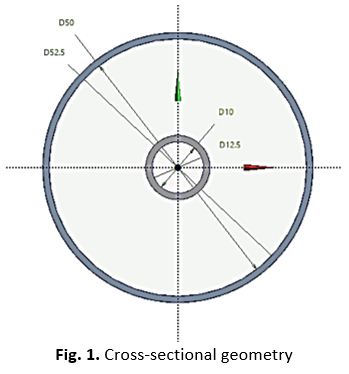
Latent Heat Thermal Energy Storage (LHTES) systems using phase change materials (PCMs) offer high energy storage density and stable operating temperatures, making them suitable for thermal energy management applications. This study investigates the melting behaviour of RT-50 PCM in a double-pipe LHTES system and evaluates the effect of heat transfer fluid (HTF) inlet velocity on the charging performance. A three-dimensional Computational Fluid Dynamics (CFD) model was developed in ANSYS Fluent using the laminar flow, energy, and solidification–melting models based on the enthalpy-porosity approach. A grid independence test was conducted using three mesh configurations, and a tetrahedral mesh containing 957,302 elements was selected for the final simulations. The melting process was analysed using liquid fraction contours and liquid fraction evolution curves for HTF inlet velocities of 20 m/s, 40 m/s, and 80 m/s. The results showed that the liquid fraction increased continuously from 0 to approximately 1.0, indicating complete melting of the PCM during the charging process. Comparison of the velocity cases revealed only minor differences in liquid fraction evolution despite a fourfold increase in HTF velocity from 20 m/s to 80 m/s. All cases exhibited similar melting trends and achieved complete melting within a comparable time period. The study concludes that PCM melting behaviour is influenced primarily by heat transfer within the PCM domain, while increasing HTF velocity provides only limited improvement in charging performance. The developed CFD model successfully captured the transient melting process and produced stable, grid-independent results.