Comparative Study of Reynolds Number Effects on Shell and Tube Heat Exchanger with Single Segmental Baffles Using CFD
DOI:
https://doi.org/10.37934/sjotfe.9.1.3648aKeywords:
Shell and tube heat exchanger, Reynolds number, pressure drop, temperature distribution, segmental baffle, CFDAbstract
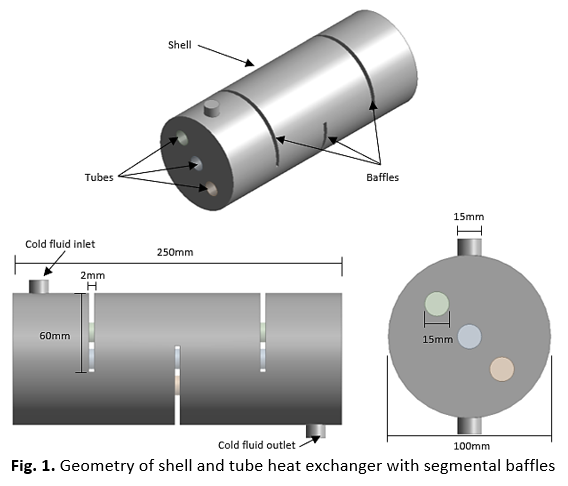
Shell and tube heat exchangers are among the most widely used heat transfer equipment in industrial applications due to their simple design, mechanical reliability, ease of maintenance, and ability to operate under high-temperature and high-pressure conditions. The incorporation of segmental baffles within the shell side enhances fluid mixing, promotes cross-flow over the tube bundle, and improves heat transfer performance. However, the increased turbulence generated by baffles may also result in higher pressure losses, which can increase pumping power requirements and operating costs. Therefore, understanding the influence of Reynolds number on both thermal and hydraulic performance is important for optimizing shell and tube heat exchanger operation. In this study, Computational Fluid Dynamics (CFD) simulations were performed to investigate the effect of Reynolds number on the performance of a shell and tube heat exchanger equipped with segmental baffles. The heat exchanger geometry consisted of a cylindrical shell with three straight tubes and segmental baffles positioned along the shell side. The Standard k-ε turbulence model was employed for all simulation cases due to its suitability for turbulent internal flow analysis. The simulation results showed that increasing Reynolds number significantly affected the hydraulic performance of the heat exchanger. The pressure drop increased from 60.44 Pa at Reynolds number 5,041 to 301.29 Pa at Reynolds number 16,803, indicating a substantial increase in flow resistance as the inlet velocity increased. In contrast, the outlet temperature exhibited only a small variation, with the hot fluid outlet temperature approaching the inlet temperature at higher Reynolds numbers. Temperature and pressure distribution analyses revealed that stronger flow mixing occurred at higher Reynolds numbers due to enhanced turbulence generated by the segmental baffles. The pressure distribution along the tube length also increased more rapidly for higher Reynolds number cases. Overall, the study demonstrates that Reynolds number has a greater influence on pressure drop than on outlet temperature for the investigated heat exchanger configuration. The findings contribute to a better understanding of the thermal-hydraulic behaviour of shell and tube heat exchangers and may assist engineers in selecting appropriate operating conditions for improved energy efficiency and system performance.