Application of Archimedes’ Principle using a Digital Strain Gauge Buoyancy Reading Prototype
DOI:
https://doi.org/10.37934/sjotfe.8.1.2330aKeywords:
Fluid mechanics, Archimedes’ principle, buoyancyAbstract
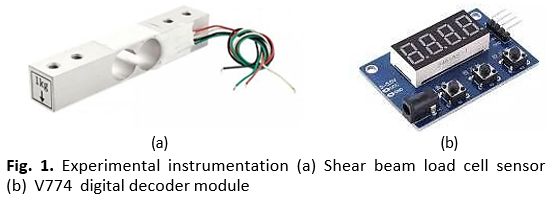
Archimedes' Principle states that the buoyancy force acts on a body which is completely or partially immersed in a fluid. This Principle is a foundation for the calculation of the densities of fluids using hydrostatic weighing. The conventional ways of determining the densities of fluids using glass hydrometers or a manual triple-beam balance have some limitations in terms of ruggedness, the potential for human error, and the lack of portability. This research was conducted to address the limitations associated with the conventional ways of measuring the densities of fluids by designing a rugged stand-alone digital density analyser for the verification of Archimedes' Principle using digital instrumentation. The objective of the research was to design a portable device for the rapid hydrostatic analysis of fluids, which is normally impossible using microcontrollers due to the instability of the signals. The research methodology was to design a rigid test stand using a shear beam load cell and a digital decoder. This setup measured the variation in the apparent weight of a constant-volume probe submerged in three distinct fluid media: freshwater, saltwater, and cooking oil. Experimental results demonstrated a clear, quantifiable inverse relationship between fluid density and the raw sensor reading; the high-density saltwater medium exerted the maximum buoyant force, resulting in the lowest tension reading, while the low- density cooking oil resulted in the highest reading. In conclusion, the developed standalone prototype successfully validates the theoretical relationship between fluid density and upthrust force, proving that optimized strain gauge technology can serve as a precise, rugged, and cost-effective alternative to analog hydrometers for non- destructive testing and educational demonstrations.