Analysis of Conjugate Heat Transfer in a Simplified Heat Exchanger

Authors

  • Ahmad Alif Ashraf Azwan Faculty of Mechanical and Manufacturing Engineering, Universiti Tun Hussein Onn Malaysia, 86400 Parit Raja, Batu Pahat, Johor, Malaysia
  • Ishkrizat Taib Faculty of Mechanical and Manufacturing Engineering, Universiti Tun Hussein Onn Malaysia, 86400 Parit Raja, Batu Pahat, Johor, Malaysia
  • Ahmad Danial Ahmad Junaidi Faculty of Mechanical and Manufacturing Engineering, Universiti Tun Hussein Onn Malaysia, 86400 Parit Raja, Batu Pahat, Johor, Malaysia
  • Ahmad Nadzim Jaafar Faculty of Mechanical and Manufacturing Engineering, Universiti Tun Hussein Onn Malaysia, 86400 Parit Raja, Batu Pahat, Johor, Malaysia
  • Aiman Akmal Mohd Farez Faculty of Mechanical and Manufacturing Engineering, Universiti Tun Hussein Onn Malaysia, 86400 Parit Raja, Batu Pahat, Johor, Malaysia
  • Eng Shao Tang Faculty of Mechanical and Manufacturing Engineering, Universiti Tun Hussein Onn Malaysia, 86400 Parit Raja, Batu Pahat, Johor, Malaysia

DOI:

https://doi.org/10.37934/sjotfe.8.1.3142a

Keywords:

Conjugate heat transfer (CHT), heat exchanger , CFD, heat transfer rate, thermal performance

Abstract

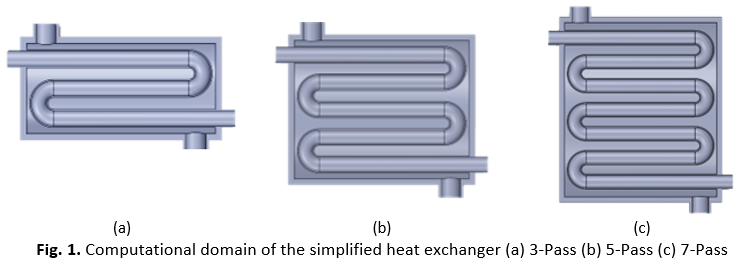
This study presents a Computational Fluid Dynamics (CFD) investigation of conjugate heat transfer (CHT) in a simplified serpentine heat exchanger under varying geometric configurations and thermal operating conditions. The objective of this research is to examine how the number of passes affects the exchanger's thermal performance, temperature distribution, and total heat transfer rate. Three configurations of 3-pass, 5-pass, and 7-pass simplified heat exchangers were designed using copper as the solid wall material and water as the tube-side working fluid. Simulations were conducted under three thermal sets with inlet and shell temperatures of 25 °C/70 °C, 15 °C/90 °C, and 10 °C/120 °C, respectively. The inlet velocity was fixed at 1 m/s, corresponding to a constant mass flow rate of 10.113 kg/s, to ensure consistent flow conditions across all cases. The results revealed that increasing the number of passes substantially enhanced heat transfer performance due to extended flow residence time and increased surface area for heat exchange. In the high-temperature difference case (10 °C/120 °C), the outlet temperature increases from 17.66 °C for the 3-pass design to 20.20 °C for the 7-pass design. Consequently, the total heat transfer rate increased from 323.96 kW to 431.38 kW, indicating a 33 % enhancement in energy absorption. Similarly, under moderate and low temperature differences, the heat transfer rates increased by 32 % and 54 %, respectively, when the pass number increased from 3 to 7. These findings confirm that the 7-pass configuration provides the most effective heat absorption across all thermal conditions. Overall, the study demonstrates that optimizing pass arrangement and flow path length significantly improves conjugate heat transfer efficiency in the simplified heat exchangers.
Author Biographies

Ahmad Alif Ashraf Azwan, Faculty of Mechanical and Manufacturing Engineering, Universiti Tun Hussein Onn Malaysia, 86400 Parit Raja, Batu Pahat, Johor, Malaysia

dd220034@student.uthm.edu.my

Ishkrizat Taib, Faculty of Mechanical and Manufacturing Engineering, Universiti Tun Hussein Onn Malaysia, 86400 Parit Raja, Batu Pahat, Johor, Malaysia

iszat@uthm.edu.my

Ahmad Danial Ahmad Junaidi, Faculty of Mechanical and Manufacturing Engineering, Universiti Tun Hussein Onn Malaysia, 86400 Parit Raja, Batu Pahat, Johor, Malaysia

dd220062@student.uthm.edu.my

Ahmad Nadzim Jaafar , Faculty of Mechanical and Manufacturing Engineering, Universiti Tun Hussein Onn Malaysia, 86400 Parit Raja, Batu Pahat, Johor, Malaysia

dd220052@student.uthm.edu.my

Aiman Akmal Mohd Farez, Faculty of Mechanical and Manufacturing Engineering, Universiti Tun Hussein Onn Malaysia, 86400 Parit Raja, Batu Pahat, Johor, Malaysia

dd200034@student.uthm.edu.my

Eng Shao Tang, Faculty of Mechanical and Manufacturing Engineering, Universiti Tun Hussein Onn Malaysia, 86400 Parit Raja, Batu Pahat, Johor, Malaysia

dd220060@student.uthm.edu.my

Downloads

Published

2026-04-02

Issue

Section

Articles