The Effectiveness of Role Plays in Teaching the Topic of Wudhu’ and its Conditions of Validity
Keywords:
Role-play, Wudhu’, Islamic education, practical learning, student engagementAbstract
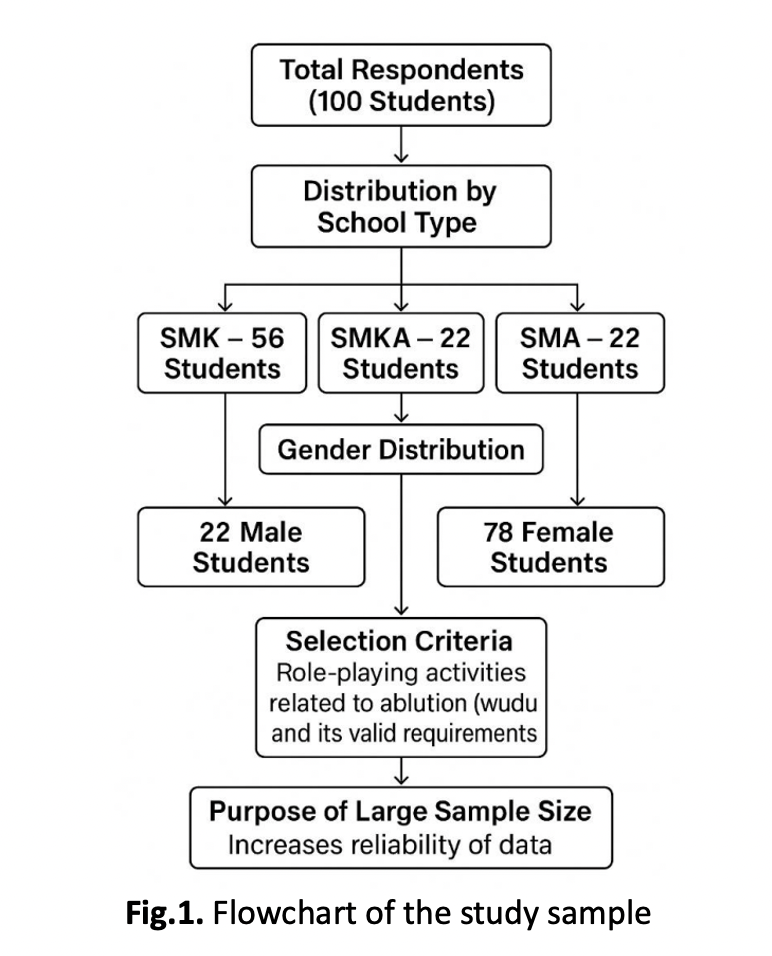
Islamic Education requires a strong integration of theoretical understanding and practical application, particularly for the topic of wudhu’ and its conditions of validity taught at the Form1 level. However, many students continue to struggle with remembering the correct sequence of wudhu’ steps and understanding its valid conditions. This confusion stems from limited opportunities for interactive practical activities, resulting in students relying on memorisation rather than meaningful comprehension. Therefore, this study examines the effectiveness of the role-play method in enhancing students’ understanding and correct performance of wudhu, to examine the effect of the role-play method on students’ engagement and active participation during the teaching and learning process of wudhu and to determine whether the use of role play improves students’ confidence and accuracy in performing wudhu independently in real-life situations. of the role-play method in enhancing students’ understanding of wudhu’ through more active and meaningful learning experiences. A quantitative descriptive design was employed using a Google Form questionnaire as the main instrument. The questionnaire consisted of two sections: Section A on demographic information (gender and school type), and Section B comprising ten five-point Likert-scale items assessing conceptual understanding, procedural skills, confidence, interest, engagement, social interaction, and comparison with traditional teaching. The study sample comprised 100 Form 1 students from SMK(56), SMKA (22), and SMA (22), including 22 males and 78 females. The findings show consistently high mean scores across all items, ranging from 4.32 to 4.60. From a cognitive perspective, students reported improved understanding of wudhu’ steps, valid conditions, and correct sequencing, with Items 1, 2, and 3 recording means between 4.47and4.58. In terms of psychomotor skills, Item 4 recorded the highest mean(4.60), indicating that role-play effectively helped students identify and correct practical errors. Affective outcomes were also positive, as Items5, 6, and 7 (means 4.45–4.58) reflected increased confidence, enjoyment, and motivation. Although Item 8 (mean 4.32) on communication confidence showed the lowest score, it remained in the high category, while Item 9 (mean 4.38) demonstrated students’ preference for role-play over lecture-based instruction. Item10(mean4.58) further affirmed the method’s effectiveness in clarifying procedural aspects of wudhu’. The study recommends improvements through structured practical sessions, more systematic use of visual aids, and greater emphasis on self-correction supported by peer and teacher feedback. Overall, the role-play method shows strong potential in enhancing conceptual understanding, skill mastery, and student engagement in learning wudhu’.