Perceptions of E-Book Use Behavior in Middle School Learning Teacher’s
Keywords:
Teacher perceptions, E-book use behavior, educational technology, use of e-books, digital transformationAbstract
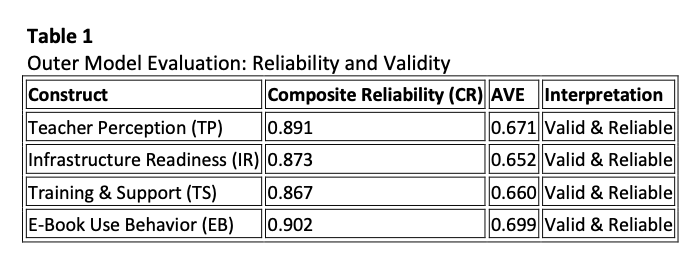
The integration of e-books in secondary school learning has gained increasing attention as a tool to enhance educational quality, flexibility, and student engagement. This study investigates teachers' perceptions regarding e-book usage behavior by combining qualitative insights with a quantitative analysis using Structural Equation Modeling with Partial Least Squares (SEM-PLS 4). Data were collected from 100 secondary school teachers across five institutions, focusing on four constructs: Teacher Perception (TP), Infrastructure Readiness (IR), Training & Support (TS), and E-Book Use Behavior (EB). The SEM-PLS analysis confirmed that all constructs met reliability and validity thresholds, with composite reliability values above 0.86 and AVE values above 0.65. Path analysis results showed that TP (β = 0.412, p < 0.001), TS (β = 0.298, p < 0.001), and IR (β = 0.215, p = 0.005) significantly influenced EB. These findings highlight that enhancing teachers’ positive attitudes, equipping them with sufficient training, and ensuring reliable infrastructure are critical to boosting e-book adoption. Qualitative results complemented these findings by uncovering themes such as increased student motivation through interactive e-book features, improved accessibility, and efficiency in material distribution. Nevertheless, challenges remain in the form of technological limitations and inadequate teacher training, which hinder optimal implementation.This research contributes to the growing body of knowledge on educational technology by emphasizing that the success of digital transformation depends not only on technology availability but also on teacher readiness and institutional support. Therefore, targeted investments in infrastructure and teacher development are imperative. By aligning strategic support with technological integration, schools can leverage e-books as a transformative tool for advancing secondary education in the digital age.