
Why So Many PhDs? —Insights from Chinese Cyberethnography Data

Authors

  • Lin Longxing Career Development and Continuing Education Department,Faculty of Educational Studies,UPM, Malaysia
  • Suriani Ismail Career Development and Continuing Education Department,Faculty of Educational Studies,UPM, Malaysia
  • Nur Aira Abd Rahim Career Development and Continuing Education Department,Faculty of Educational Studies,UPM, Malaysia

Keywords:

Chinese doctoral education, cyberethnography, qualitative research, online forums, social cognition, motivation interpretation

Abstract

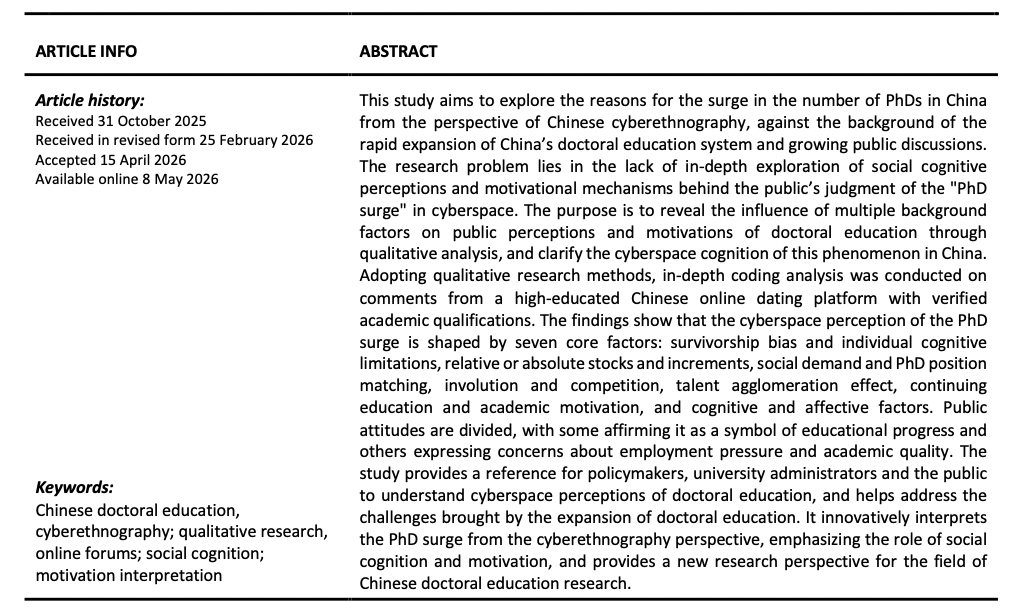
This study aims to explore the reasons for the surge in the number of PhDs in China from the perspective of Chinese cyberethnography, against the background of the rapid expansion of China’s doctoral education system and growing public discussions. The research problem lies in the lack of in-depth exploration of social cognitive perceptions and motivational mechanisms behind the public’s judgment of the "PhD surge" in cyberspace. The purpose is to reveal the influence of multiple background factors on public perceptions and motivations of doctoral education through qualitative analysis, and clarify the cyberspace cognition of this phenomenon in China. Adopting qualitative research methods, in-depth coding analysis was conducted on comments from a high-educated Chinese online dating platform with verified academic qualifications. The findings show that the cyberspace perception of the PhD surge is shaped by seven core factors: survivorship bias and individual cognitive limitations, relative or absolute stocks and increments, social demand and PhD position matching, involution and competition, talent agglomeration effect, continuing education and academic motivation, and cognitive and affective factors. Public attitudes are divided, with some affirming it as a symbol of educational progress and others expressing concerns about employment pressure and academic quality. The study provides a reference for policymakers, university administrators and the public to understand cyberspace perceptions of doctoral education, and helps address the challenges brought by the expansion of doctoral education. It innovatively interprets the PhD surge from the cyberethnography perspective, emphasizing the role of social cognition and motivation, and provides a new research perspective for the field of Chinese doctoral education research.

Author Biographies

Lin Longxing, Career Development and Continuing Education Department,Faculty of Educational Studies,UPM, Malaysia

gs68469@student.upm.edu.my

Suriani Ismail, Career Development and Continuing Education Department,Faculty of Educational Studies,UPM, Malaysia

suriani_ismail@upm.edu.my

Nur Aira Abd Rahim, Career Development and Continuing Education Department,Faculty of Educational Studies,UPM, Malaysia

nuraira@upm.edu.my

Downloads

Published

2026-05-09

Issue

Section

Articles