

A Piecewise Bezier Surface Interpolation Model for Facial Surface Visualization

Authors

  • Mohammad Izat Emir Zulkifly Department of Mathematics, Faculty of Sciences, University Teknologi Malaysia (UTM) 81310, Johor Bharu, Malaysia
  • Nur Azlida Ahmad 1 Department of Foundation and Diploma Studies, College of Computing and Informatic, Jalan IKRAM-UNITEN,University Tenaga National (UNITEN), 43000 Kajang, Selangor, Malaysia
  • Said Broumi Department of Mathematics SIMATS Engineering, Saveetha Institute of Medical and Technical Sciences Thandalam Chennai, Tamilnadu India

Keywords:

Piecewise Bézier surface, facial surface visualization, facial landmark interpolation, parametric surface modeling, computer-aided geometric design

Abstract

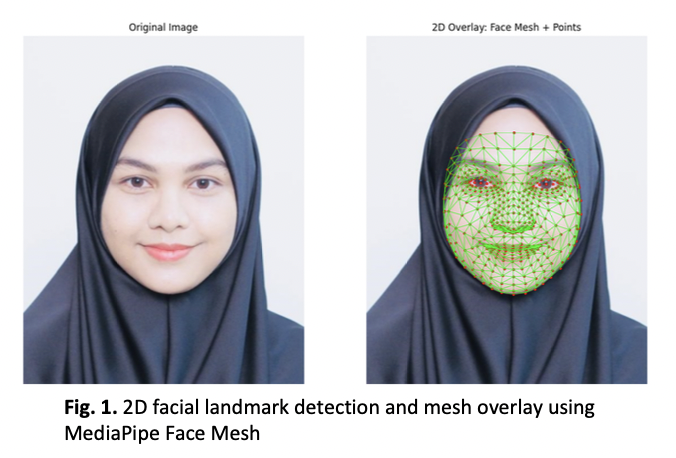
Facial surface visualization is a fundamental task in geometric modeling, particularly for applications that require smooth and accurate representation of facial geometry. This paper proposes a piecewise Bézier surface interpolation model for the visualization of facial surfaces constructed from facial landmark data. The proposed approach partitions the facial parametric domain into multiple overlapping patches, where each patch is interpolated independently using a tensor-product Bézier surface formulation. Bernstein polynomial basis functions are employed to compute the surface control points through a least-squares interpolation strategy. A Gaussian blending mechanism is subsequently applied to ensure smooth transitions and geometric continuity between adjacent patches. The resulting composite Bézier surface produces a continuous and visually coherent facial surface while preserving essential geometric characteristics such as curvature variation and boundary structure. Experimental results demonstrate that the proposed model achieves stable and smooth surface visualization even when constructed from sparse facial landmark data. These findings indicate that the proposed piecewise Bézier surface interpolation framework provides an effective and mathematically well-defined solution for facial geometry visualization and computer-aided geometric design applications.

Author Biographies

Mohammad Izat Emir Zulkifly, Department of Mathematics, Faculty of Sciences, University Teknologi Malaysia (UTM) 81310, Johor Bharu, Malaysia

izatemir@utm.my

Nur Azlida Ahmad, 1 Department of Foundation and Diploma Studies, College of Computing and Informatic, Jalan IKRAM-UNITEN,University Tenaga National (UNITEN), 43000 Kajang, Selangor, Malaysia

azlida@graduate.utm.my

Said Broumi, Department of Mathematics SIMATS Engineering, Saveetha Institute of Medical and Technical Sciences Thandalam Chennai, Tamilnadu India

broumisaid78@gmail.com

Downloads

Published

2026-06-08

Issue

Section

Articles