Thermal and Electrical Properties of Zinc-Strontium-Lithium Phosphate Glass Doped with Carboxymethyl Cellulose

Authors

  • Siti Norfariza Farhana Mohd Razak Advanced Optical Materials Research Group, Faculty of Science, Universiti Teknologi Malaysia, Johor, Skudai, 81310, Malaysia
  • Farhana Mohamiddin Advanced Optical Materials Research Group, Faculty of Science, Universiti Teknologi Malaysia, Johor, Skudai, 81310, Malaysia
  • Nurhafizah Hasim Advanced Optical Materials Research Group, Faculty of Science, Universiti Teknologi Malaysia, Johor, Skudai, 81310, Malaysia
  • Nur Hidayah Ahmad Advanced Optical Materials Research Group, Faculty of Science, Universiti Teknologi Malaysia, Johor, Skudai, 81310, Malaysia
  • Norshahirah Mohamad Saidi Advanced Optical Materials Research Group, Faculty of Science, Universiti Teknologi Malaysia, Johor, Skudai, 81310, Malaysia
  • Mohd Fuad Mohamd Department of Chemistry, Faculty of Science, Universiti Teknologi Malaysia, Johor, Skudai, 81310, Malaysia
  • Anis Nazihah Mat Daud Department of Physics, Faculty of Science and Mathematics, Universiti Pendidikan Sultan Idris, 35900 Tanjung Malim, Perak, Malaysia

Keywords:

Phosphate glass, DTA, EIS

Abstract

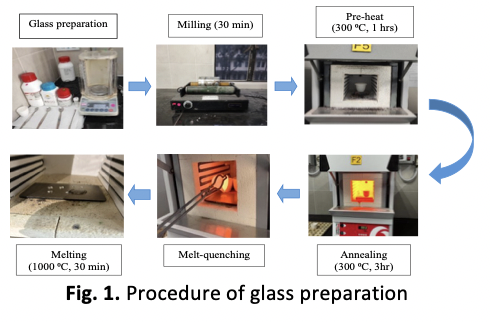
The influence of Carboxymethyl Cellulose (CMC) on the thermal and electrical properties of phosphate glass has attracted considerable attention, yet its mechanistic role in modifying glass structure remains insufficiently understood. This study aims to synthesize and characterize phosphate glasses with composition (40−x)P₂O₅–30ZnO–25Li₂O–5SrO–(x)CH₂COOH (0.0 ≤ x ≤ 0.5 mol%) to elucidate how CMC incorporation reshapes the glass network and alters its physical, thermal, and electrical behavior. The glasses were prepared by melt-quenching and characterized using XRD, DTA, and EIS analyses. Density increased from 2.604 to 3.194 g/cm³ and molar volume decreased to 29.326 cm³·mol⁻¹ at 0.2 mol% CMC, indicating stronger network compaction. The optimal composition at 0.2 mol% CMC exhibited the highest ionic conductivity (2.89 ×10⁻⁷ S·cm⁻¹) and lowest activation energy (1.20×10⁻² eV). This enhancement arises from CMC’s carboxylate groups, which form hydrogen-bonded linkages with phosphate tetrahedra and stabilize Li⁺ pathways within the matrix. The findings demonstrate that low-level CMC addition effectively tunes network rigidity, ionic mobility, and dielectric response, providing a green and sustainable strategy for tailoring the performance of phosphate-based functional glasses.
Author Biographies

Siti Norfariza Farhana Mohd Razak, Advanced Optical Materials Research Group, Faculty of Science, Universiti Teknologi Malaysia, Johor, Skudai, 81310, Malaysia

sitinorfarizafarhana@graduate.utm.my

Farhana Mohamiddin, Advanced Optical Materials Research Group, Faculty of Science, Universiti Teknologi Malaysia, Johor, Skudai, 81310, Malaysia

farhana00@graduate.utm.my

Nurhafizah Hasim, Advanced Optical Materials Research Group, Faculty of Science, Universiti Teknologi Malaysia, Johor, Skudai, 81310, Malaysia

nurhafizah.h@utm.my

Nur Hidayah Ahmad, Advanced Optical Materials Research Group, Faculty of Science, Universiti Teknologi Malaysia, Johor, Skudai, 81310, Malaysia

nurhidayahahmad@utm.my

Norshahirah Mohamad Saidi, Advanced Optical Materials Research Group, Faculty of Science, Universiti Teknologi Malaysia, Johor, Skudai, 81310, Malaysia

norshahirah.ms@utm.my

Mohd Fuad Mohamd, Department of Chemistry, Faculty of Science, Universiti Teknologi Malaysia, Johor, Skudai, 81310, Malaysia

m.fuad@utm.my

Anis Nazihah Mat Daud, Department of Physics, Faculty of Science and Mathematics, Universiti Pendidikan Sultan Idris, 35900 Tanjung Malim, Perak, Malaysia

anis.md@fsmt.upsi.edu.my

Downloads

Published

2025-11-27

How to Cite

Mohd Razak, S. N. F., Mohamiddin, F., Hasim, N., Ahmad, N. H., Mohamad Saidi, N., Mohamd, M. F., & Mat Daud, A. N. (2025). Thermal and Electrical Properties of Zinc-Strontium-Lithium Phosphate Glass Doped with Carboxymethyl Cellulose. Semarak International Journal of Electronic System Engineering, 7(1), 22–32. Retrieved from https://semarakilmu.my/index.php/sijese/article/view/869

Issue

Section

Articles