Evanescent Field Absorption Sensor Based on Plastic Optical Fiber: Effect of Fiber Geometry
Keywords:
Plastic optical fiber, evanescent, ethanol detection, fiber geometryAbstract
Optical fiber sensors based on evanescent wave absorption have attracted significant attention due to their high sensitivity and advantages over conventional sensing technologies. Despite these advantages, optimizing structural parameters and geometrical configurations to enhance sensor performance remains a significant challenge. This study aims to evaluate the influence of core diameter, exposed length, and fiber geometry on the evanescent wave absorption characteristics of unclad optical fibers. Unclad fibers were fabricated using an acetone-based etching technique and configured into U-shaped, spiral, and wave-shaped designs with varying core diameters and exposed lengths. The sensing performance was assessed by immersing the unclad regions in ethanol solutions with concentrations ranging from 10 wt% to 50 wt%. The interaction between the guided light and surrounding medium was analyzed in terms of penetration depth, evanescent wave absorption coefficient, sensitivity, and efficiency. The results indicate that fibers with larger core diameters, longer exposed lengths (6 cm), and wave-shaped configurations exhibited the highest evanescent wave coefficients and sensitivity. Increasing ethanol concentration increased the penetration depth from 253.8 nm to 315.57 nm, thereby enhancing absorption and improving overall sensor performance.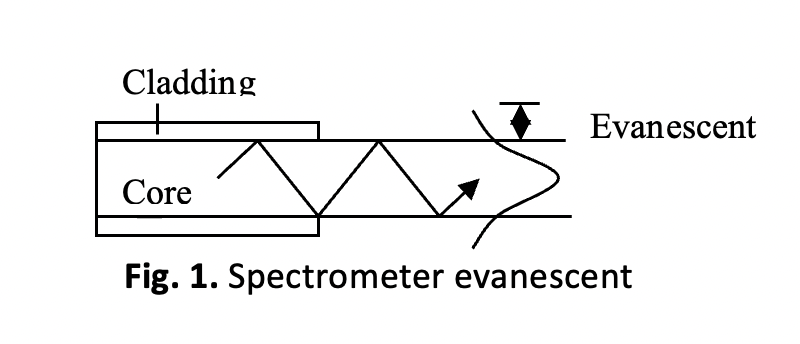
Downloads
Published
2026-05-23
How to Cite
Muhammad Nil Yafiq Mohd Yusof, Affa Rozana Abdul Rashid, Wan Maisarah Mukhtar, & Daniel Ashraf Zainal. (2026). Evanescent Field Absorption Sensor Based on Plastic Optical Fiber: Effect of Fiber Geometry. Semarak International Journal of Electronic System Engineering, 9(1), 13–20. Retrieved from https://semarakilmu.my/index.php/sijese/article/view/1124
Issue
Section
Articles