Organizational Behaviour and Employee Performance in Nigeria: Challenges and Prospects for Sustainable Organizational Development
Keywords:
Organizational behavior, employee performance, leadership, workplace culture, employee motivation, NigeriaAbstract
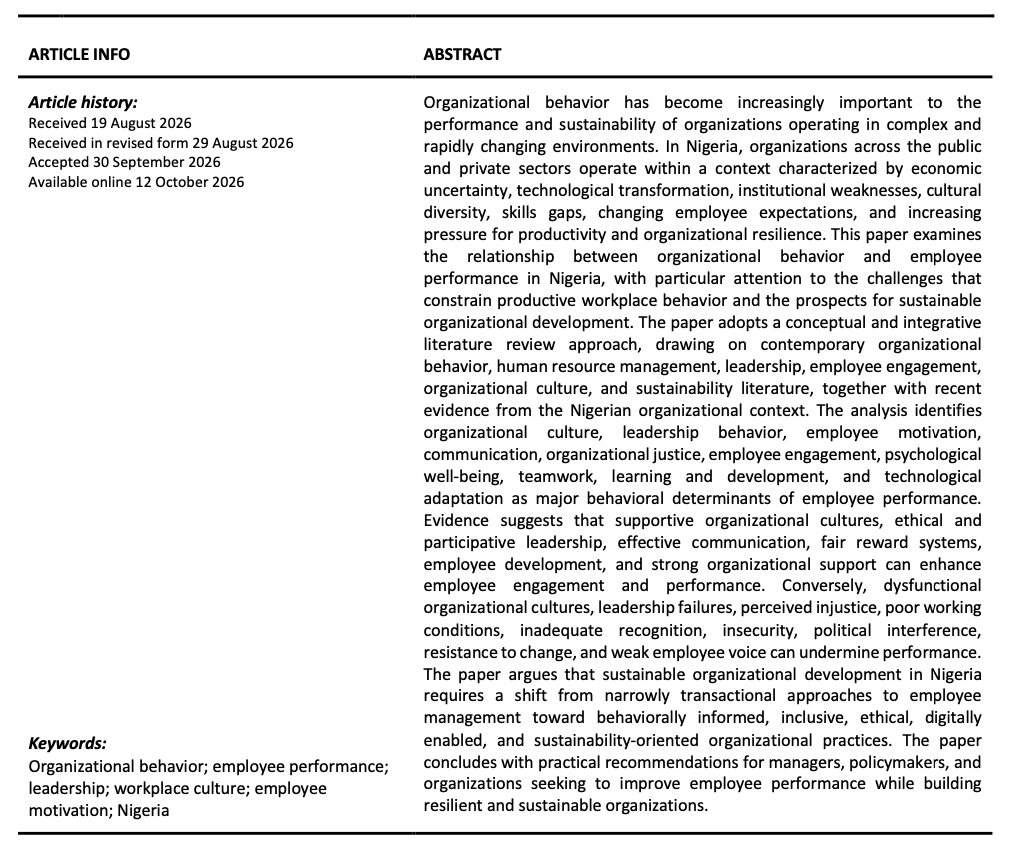
Organizational behavior has become increasingly important to the performance and sustainability of organizations operating in complex and rapidly changing environments. In Nigeria, organizations across the public and private sectors operate within a context characterized by economic uncertainty, technological transformation, institutional weaknesses, cultural diversity, skills gaps, changing employee expectations, and increasing pressure for productivity and organizational resilience. This paper examines the relationship between organizational behavior and employee performance in Nigeria, with particular attention to the challenges that constrain productive workplace behavior and the prospects for sustainable organizational development. The paper adopts a conceptual and integrative literature review approach, drawing on contemporary organizational behavior, human resource management, leadership, employee engagement, organizational culture, and sustainability literature, together with recent evidence from the Nigerian organizational context. The analysis identifies organizational culture, leadership behavior, employee motivation, communication, organizational justice, employee engagement, psychological well-being, teamwork, learning and development, and technological adaptation as major behavioral determinants of employee performance. Evidence suggests that supportive organizational cultures, ethical and participative leadership, effective communication, fair reward systems, employee development, and strong organizational support can enhance employee engagement and performance. Conversely, dysfunctional organizational cultures, leadership failures, perceived injustice, poor working conditions, inadequate recognition, insecurity, political interference, resistance to change, and weak employee voice can undermine performance. The paper argues that sustainable organizational development in Nigeria requires a shift from narrowly transactional approaches to employee management toward behaviorally informed, inclusive, ethical, digitally enabled, and sustainability-oriented organizational practices. The paper concludes with practical recommendations for managers, policymakers, and organizations seeking to improve employee performance while building resilient and sustainable organizations.