Reading Self-Efficacy and Reading Proficiency: A Correlational Study
Keywords:
Test, reading self-efficacy, reading proficiencyAbstract
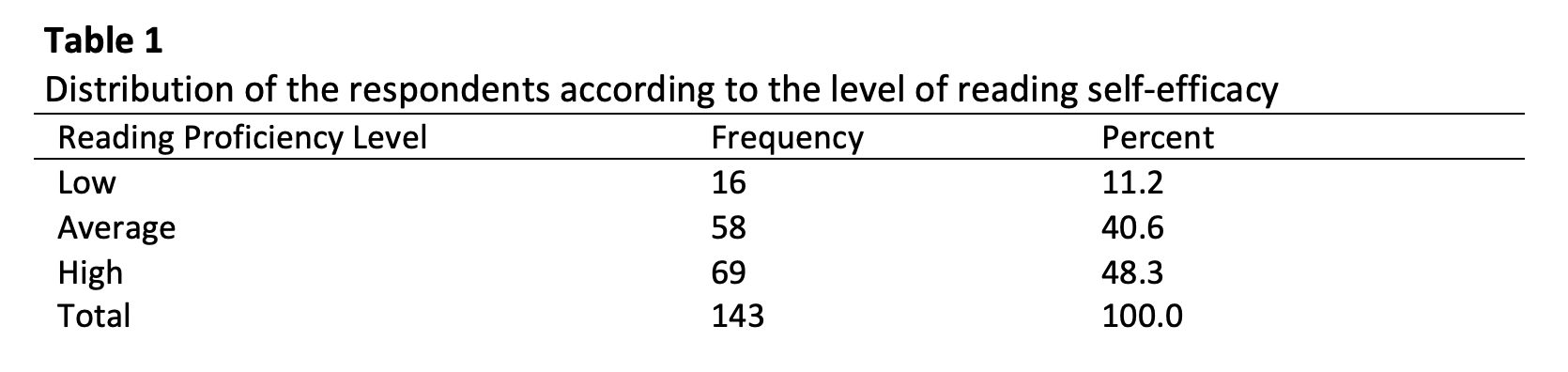
Reading is a basic competency that leads to many other competencies, and having proficiency in it means having an advantage in life. This study determines the relationship between reading self-efficacy and reading proficiency among Grade VII students, particularly their self-perception in the achievement of their assigned reading task and the result of their reading competence. Specifically, it investigated the link between their perceived self-confidence and their ability to read and comprehend. A total of 143 respondents took three tests, such as the Reading Self-Efficacy Questionnaire, the PHIL-IRI Oral Test, and the PHIL-IRI Silent and Comprehension Test. These tests determine their self-perception and proficiency in reading, specifically their oral and comprehension competency. The data were gathered through a researcher-made reading self-efficacy questionnaire that measured the learners’ belief in students’ ability to complete various reading tasks and reach their reading goals, to assess their reading comprehension, vocabulary, and word recognition in oral reading, and to test their reading comprehension in silent reading. The result reveals that the reading self-efficacy among respondents is high, but their reading proficiency was 67.8%, which is described as a frustration level. Lastly, there is a significant but inverse relationship between self-efficacy and reading proficiency, suggesting that positive self-perception does not automatically lead to better reading competency, which is an overestimation of oneself, or delusional confidence, leading to low reading proficiency. Lastly, this study shows the significance of achieving a positive relationship between reading self-efficacy and reading proficiency to ensure an appropriate teaching-learning environment.