Idrāj in the Texts of Hadith and Its Implications for the Derivation of Fiqh Rulings
Keywords:
Idrāj, text of hadith, fiqh, ‘ulūm al-hadith, narratorAbstract
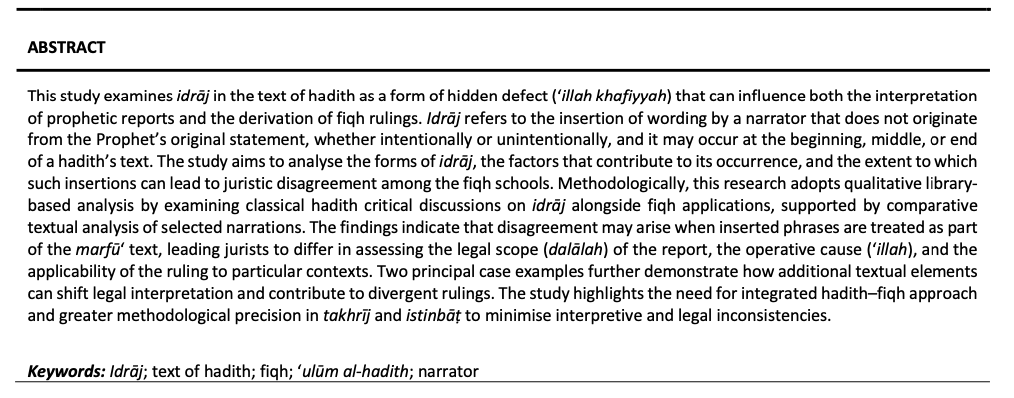
This study examines idrāj in the text of hadith as a form of hidden defect (‘illah khafiyyah) that can influence both the interpretation of prophetic reports and the derivation of fiqh rulings. Idrāj refers to the insertion of wording by a narrator that does not originate from the Prophet’s original statement, whether intentionally or unintentionally, and it may occur at the beginning, middle, or end of a hadith’s text. The study aims to analyse the forms of idrāj, the factors that contribute to its occurrence, and the extent to which such insertions can lead to juristic disagreement among the fiqh schools. Methodologically, this research adopts qualitative library-based analysis by examining classical hadith critical discussions on idrājalongside fiqh applications, supported by comparative textual analysis of selected narrations. The findings indicate that disagreement may arise when inserted phrases are treated as part of the marfū‘ text, leading jurists to differ in assessing the legal scope (dalālah) of the report, the operative cause (‘illah), and the applicability of the ruling to particular contexts. Two principal case examples further demonstrate how additional textual elements can shift legal interpretation and contribute to divergent rulings. The study highlights the need for integrated hadith–fiqh approach and greater methodological precision in takhrīj and istinbāṭ to minimise interpretive and legal inconsistencies.