Temporal Changes in Seaweed Diversity and Abundance at Pulau Merambong, Johor: Progress and Impacts of Land Reclamation From 2014 to 2025
Keywords:
Anthropogenic, impact, marine, seaweedAbstract
Merambong Island is rich in seaweed biodiversity, despite ongoing long-term environmental disturbances such as land reclamation and shipping activities. This study assessed the temporal changes in seaweed diversity and abundance in Merambong Island from 2014 to 2025, focusing on progress and ecological impacts from the land reclamation for Forest City development. Physical specimens that were growing as epipsammic, epiphytic, epilithic, epizooic, and epipelic as well as on artificial substrate were collected using a destructive line transect-quadrat method. A total of 86 seaweed species have been recorded from 2014 to 2025, across five survey years representing pre-reclamation (2014), during reclamation (2016), and three post-reclamation periods (2019, early 2024 and late 2024). One-way ANOVA showed significant differences, where p = 0.01 (p < 0.05) that indicated substantial temporal variation. Cladophora stimpsonii was identified as the dominant species in Merambong Island for the recent observation in late 2024. The successfully acclimatized species throughout 2014 to 2025 observation were Avrainvillea erecta, Caulerpa sertularioides, Gracilaria salicornia, Hypnea spinella and Padina minor. Thirteen genera (Acanthophora, Avrainvillea, Bryopsis, Caulerpa, Cladophora, Dictyota, Halimeda, Jania, Laurencia, Padina, Sargassum, Tolypiocladia, and Ulva) were only observed pre-, during and post-reclamation but were absent from the most recent observation in late 2024, suggesting that they are sensitive to environmental disturbances. Comparative analysis pre-reclamation (2014) and post-reclamation (early 2024) indicated a decline in seaweed diversity. However, by late 2024 there was evidence of ongoing recovery of opportunistic species such as Caulerpa lentillifera. Long term monitoring revealed significant changes in species composition, spatial coverage and community structure throughout the environmental disturbance.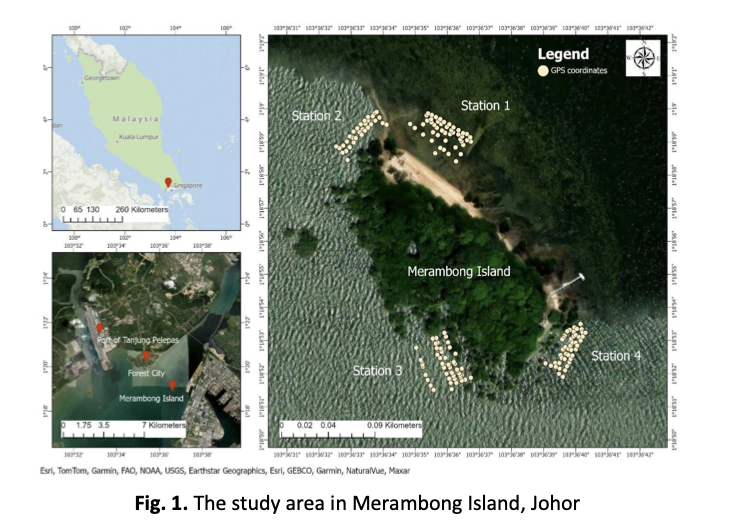
Downloads
Published
2026-06-07
How to Cite
Wan Dhiya Ainin Sofiya, Nur Farah Ain Zainee, Nur Aliah Mohamad Khaduwi, Mohammad Rozaimi, Nur Amira Batrisyia Isham, Juria Bacha Kenedy, & Mohamed Effendi Taip. (2026). Temporal Changes in Seaweed Diversity and Abundance at Pulau Merambong, Johor: Progress and Impacts of Land Reclamation From 2014 to 2025 . Semarak Proceedings of Natural and Environmental Sciences, 4(1), 123–127. Retrieved from https://semarakilmu.my/index.php/spnes/article/view/1127
Issue
Section
Articles