Epicuticular Wax Content on Leaf Epidermis of Selected Brassica L. Taxa in Relation to Feeding Behaviour Against Diamondback Moth, Plutella xylostella L. (Lepidoptera: Plutellidae) Larvae

Authors

  • Noraini Talip Department of Biological Sciences and Biotechnology, Faculty of Science and Technology, Universiti Kebangsaan Malaysia, 43600 Bangi, Selangor, Malaysia
  • Syamsurina Ahmad Department of Biological Sciences and Biotechnology, Faculty of Science and Technology, Universiti Kebangsaan Malaysia, 43600 Bangi, Selangor, Malaysia
  • Idris Abd Ghani Department of Biological Sciences and Biotechnology, Faculty of Science and Technology, Universiti Kebangsaan Malaysia, 43600 Bangi, Selangor, Malaysia
  • Mohd Norfaizal Ghazalli Malaysian Agriculture Research Institute, Serdang 43400, Selangor, Malaysia
  • Ahmad Fitri Zohari Department of Biological Sciences and Biotechnology, Faculty of Science and Technology, Universiti Kebangsaan Malaysia, 43600 Bangi, Selangor, Malaysia
  • Nur Syazwani Basir Department of Biological Sciences and Biotechnology, Faculty of Science and Technology, Universiti Kebangsaan Malaysia, 43600 Bangi, Selangor, Malaysia

Keywords:

Epicuticular, Brassicaceae, leaf micromorphology, waxes, DBM larvae

Abstract

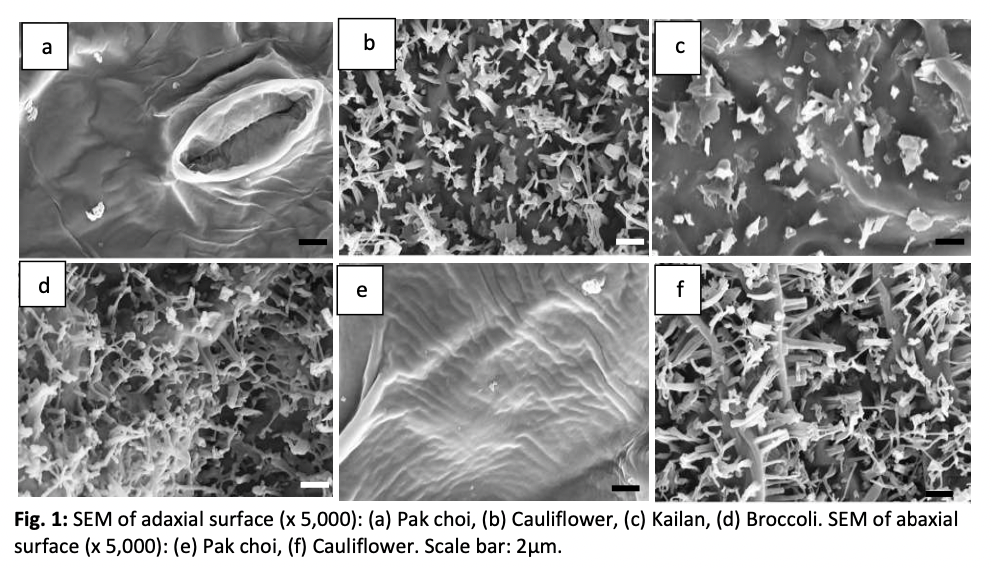
Many aspects of epicuticular waxes have been studied over the years. In plants, the epicuticular wax layer provides a protective barrier, which consists predominantly of long-chain hydrocarbon compounds, including alkanes, primary alcohols, aldehydes, secondary alcohols, ketones, esters, and other derived compounds. However, there is a limited understanding of the relationship between animal or insect-eating habits and plant micromorphological characteristics. This study investigated the impact of epicuticular wax content in five selected taxa of Brassica L. on the feeding behaviour of diamondback moth (DBM), Plutella xylostella L., using observation under the scanning electron microscope (SEM). The findings have revealed that the epicuticular waxes' morphology content was composed primarily of rodlets, flakes, thread-like, granular, and smooth film coating. The analysis was conducted using a one-way analysis of variance (ANOVA). Findings have shown that there was a significant difference regarding the time spent on feeding by the larvae of the 3rd instar of the DBM both in choice (F = 510.58, df = 5 & 54, P < 0.05) and no-choice tests (F = 38.92, df = 5 & 54, P < 0.05) to the epicuticular wax content in Brassica leaves. These insect pests showed a weak preference for leaves with high epicuticular wax. It was concluded that the variation in waxes present in the Brassica taxa studied has great significance as a mechanical barrier to the DBM larvae.
Author Biographies

Noraini Talip, Department of Biological Sciences and Biotechnology, Faculty of Science and Technology, Universiti Kebangsaan Malaysia, 43600 Bangi, Selangor, Malaysia

ntalip@ukm.edu.my

Syamsurina Ahmad, Department of Biological Sciences and Biotechnology, Faculty of Science and Technology, Universiti Kebangsaan Malaysia, 43600 Bangi, Selangor, Malaysia

rin_yadiy@yahoo.com

Idris Abd Ghani, Department of Biological Sciences and Biotechnology, Faculty of Science and Technology, Universiti Kebangsaan Malaysia, 43600 Bangi, Selangor, Malaysia

idrisgh@ukm.edu.my

Mohd Norfaizal Ghazalli, Malaysian Agriculture Research Institute, Serdang 43400, Selangor, Malaysia

Mohd.n.faizal.ghazalli@gmail.com

Ahmad Fitri Zohari, Department of Biological Sciences and Biotechnology, Faculty of Science and Technology, Universiti Kebangsaan Malaysia, 43600 Bangi, Selangor, Malaysia

ahmadfitri@ukm.edu.my

Nur Syazwani Basir, Department of Biological Sciences and Biotechnology, Faculty of Science and Technology, Universiti Kebangsaan Malaysia, 43600 Bangi, Selangor, Malaysia

syazwani.basir@ukm.edu.my

Downloads

Published

2026-05-17

How to Cite

Talip, N., Ahmad, S., Abd Ghani, I., Ghazalli, M. N., Zohari, A. F., & Basir, N. S. (2026). Epicuticular Wax Content on Leaf Epidermis of Selected Brassica L. Taxa in Relation to Feeding Behaviour Against Diamondback Moth, Plutella xylostella L. (Lepidoptera: Plutellidae) Larvae. Semarak Proceedings of Natural and Environmental Sciences, 4(1), 119–122. Retrieved from https://semarakilmu.my/index.php/spnes/article/view/1110

Issue

Section

Articles