Multifunctional PNSB as a Live Feed Enhancer: Improving Artemia Performance and Disease Resistance
Keywords:
Artemia, Rhodopseudomonas palustris, probiotics, single-cell protein, nutritional quality, carotenoids, immune responseAbstract
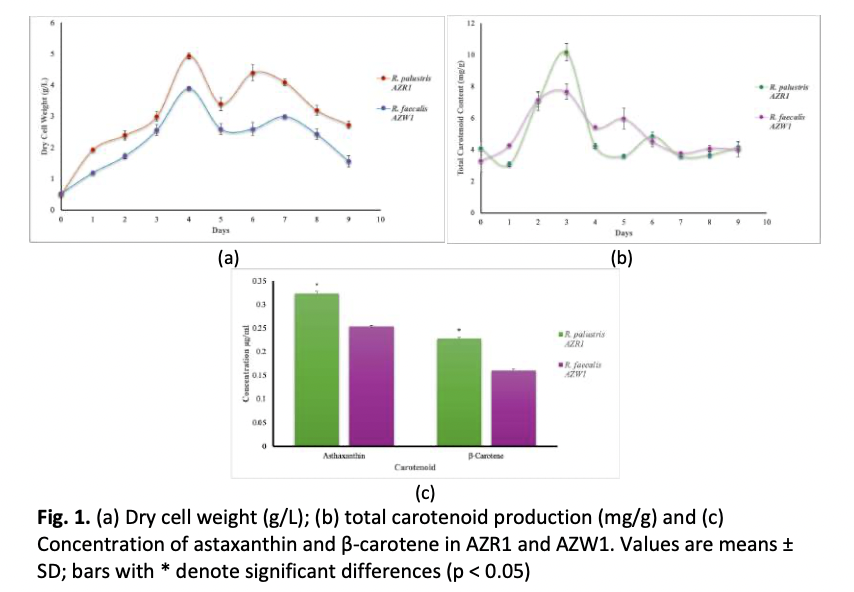
The application of Artemia as a live feed in aquaculture is often limited by the high cost and variable quality of commercial cysts. This study explores the potential of two mangrove-associated purple non-sulfur bacteria (PNSB) strains - Rhodopseudomonas palustris AZR1 and Rhodopseudomonas faecalis AZW1 - as probiotic feed supplements to enhance the nutritional and health status of Artemia. The Artemia-fed treatments (AFT) received yeast and Artemia twice daily at 3.0 x 10⁷ cells/mL for 14 days, whereas the PKC Nutri+ treatment was maintained at an OD600 of 0.3. Flavonoid contents in the PNSB strains and Artemia-fed treatments (AFT) were measured by spectrophotometry and HPLC. Nutritional contents were assessed using proximate analysis, and fatty acid contents were quantified via GC-MS. Twenty AFT were challenge with 1 × 10⁸ CFU/mL of Vibrio campbellii and survival were observed after 72hr. Strain characterization revealed that R. palustris AZR1 exhibited superior carotenoid production, with significantly higher astaxanthin (0.324 μg/mL) and β-carotene (0.228 μg/mL) levels compared to R. faecalis AZW1 (0.254 and 0.160 μg/mL, respectively; p < 0.05). Additionally, R. palustris AZR1 showed a significantly greater total lipid content (7.77%) than R. faecalis AZW1 (6.76%; p < 0.05), despite overall comparable nutritional profiles. When used as a live feed, R. palustris AZR1 significantly enhanced Artemia growth, with differences becoming statistically significant from Day 4 onward (p < 0.05). Under gnotobiotic conditions, Artemia fed R. palustris AZR1 reached a mean length of 9.6 ± 0.32 mm by Day 14, outperforming those fed PKC Nutri+ (7.6 ± 0.43 mm) and yeast (7.5 ± 0.25 mm). A similar growth advantage was observed under hatchery conditions, where R. palustris AZR1-fed Artemia attained the highest length (10.1 ± 0.08 mm), surpassing both PKC Nutri+ (9.7 ± 0.55 mm) and yeast (8.5 ± 0.36 mm). Moreover, Artemia supplemented with R. palustris AZR1 demonstrated enhanced resistance to Vibrio campbellii challenge, which correlated with the upregulation of key immune-related genes, including Hsp70, Hsp90, and proPO. Nutritional analysis confirmed effective transfer of beneficial biomolecules, including carotenoids and lipids, from the PNSB to Artemia. While PKC Nutri+ was richer in polyunsaturated fatty acids (PUFAs), R. palustris AZR1 offers a safer, toxin-free alternative. In conclusion, this study highlights the potential of the mangrove-derived R. palustris AZR1 as a sustainable, multifunctional single-cell protein source with strong probiotic properties, capable of improving Artemia growth, immune competence, and nutritional quality in aquaculture systems.