From Natural to Anthropogenic: Comparative Analysis of House Crow Nesting Strategies in Urban and Rural Penang Environments
Keywords:
Invasive species, nest materials, anthropogenic resources, natural resourcesAbstract
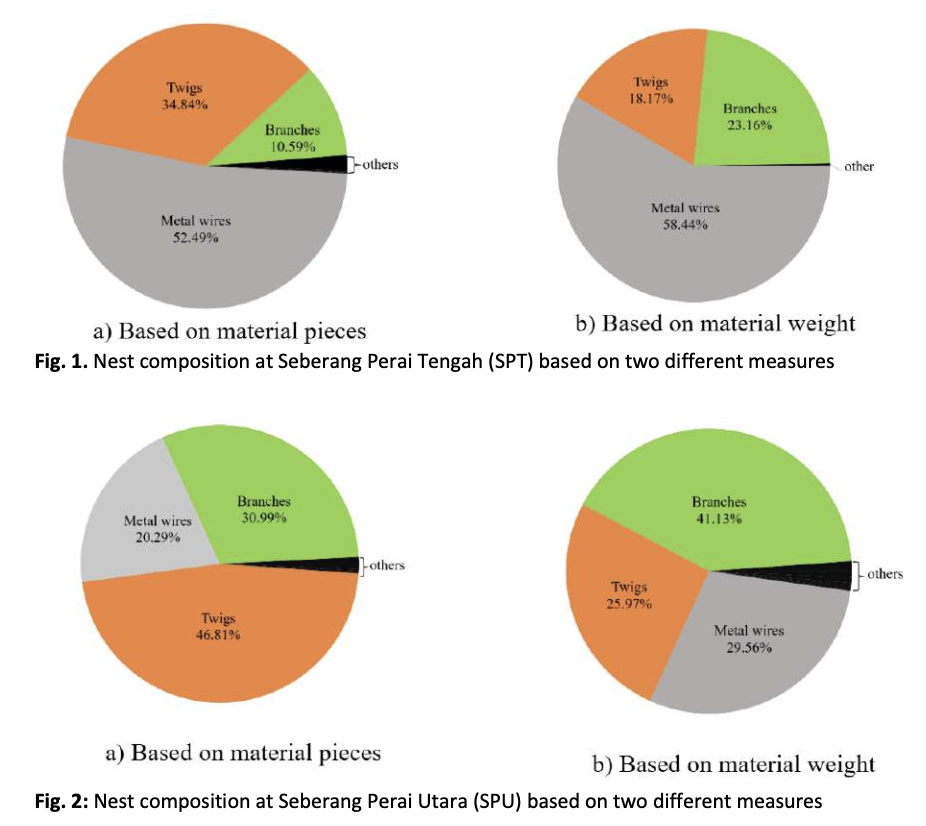
The House Crow (Corvus splendens) exhibits exceptional generalist traits that enable its survival across diverse anthropogenic landscapes. Understanding how urbanization influences nesting behavior is crucial for managing this invasive species in Southeast Asia. This study investigates nest composition and identifies key factors influencing nest-site selection across an urbanization gradient in mainland Penang, Malaysia. Two contrasting sites were examined: Seberang Perai Tengah (SPT, urban site) and Seberang Perai Utara (SPU, rural/agricultural site). Forty-seven nests (30 from SPT, 17 from SPU) were systematically collected and analyzed for construction materials. Results revealed dramatic site-specific differences in material selection. Urban nests were dominated by metal wires (52.49% by count, 58.44% by weight), while rural nests primarily utilized natural materials—twigs (46.81% by count) and small branches (41.00% by weight). Both sites demonstrated heavy reliance on anthropogenic resources, with artificial nest materials (waste bins, construction sites, recycling centers, residential areas) more abundant than natural alternatives (95% urban, 73% rural). Nest-site preferences also differed between habitats. Urban crows selected trees with 70-100% canopy cover near food resources (mean distance = 300.35 ± 161.28 m), while rural crows preferred trees 4-9 m tall with canopies <15 m wide near water resources (mean distance = 402.13 ± 233.91 m). These findings highlight the House Crow's remarkable behavioral plasticity in response to urbanization, with nesting strategies shaped by local resource availability and tree architecture, providing insights for urban wildlife management.