Population Census and Ranging Pattern of The Long-Tailed Macaques (Macaca fascicularis) at Human-Altered Environment

Authors

  • Aslari Effendy N.H. Department of Biological Science and Biotechnology, Faculty of Science and Technology,Universiti Kebangsaan Malaysia, 43600 Bangi, Selangor, Malaysia
  • Jamaluddin M.I. Department of Biological Science and Biotechnology, Faculty of Science and Technology,Universiti Kebangsaan Malaysia, 43600 Bangi, Selangor, Malaysia
  • Zainul Abidin K. Faculty of Applied Sciences, Universiti Teknologi MARA Pahang, 26400 Bandar Tun Abdul Razak, Jengka, Pahang, Malaysia
  • Md-Zain B.M. Department of Biological Science and Biotechnology, Faculty of Science and Technology,Universiti Kebangsaan Malaysia, 43600 Bangi, Selangor, Malaysia
  • Mohd-Daut N Department of Biological Science and Biotechnology, Faculty of Science and Technology,Universiti Kebangsaan Malaysia, 43600 Bangi, Selangor, Malaysia

Keywords:

Ranging area, core area, group composition, overlap, territories

Abstract

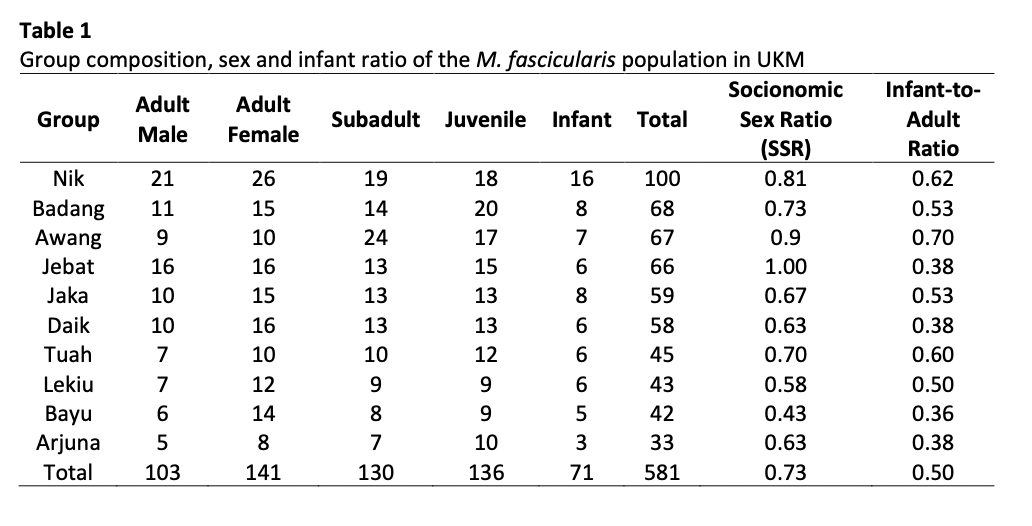
The Universiti Kebangsaan Malaysia (UKM), Bangi campus is located within the natural habitat of the long-tailed macaque (Macaca fascicularis). Its proximity to surrounding forested areas has resulted in a high degree of habituation among the macaques toward human presence. However, data on their population size and ranging patterns remain limited. This study aimed to determine the population size and ranging areas of habituated long-tailed macaques within the UKM main campus. Systematic field surveys were conducted from October 2021 to October 2022, involving group identification, population census, and GPS-based location mapping. Ranging areas were calculated using the Minimum Convex Polygon (MCP) and 95% Kernel Density Estimation (KDE) methods. Core areas and disturbance zones were further delineated for each identified group. A total of 10 macaque groups comprising 581 individuals were recorded across the campus. Based on 965 GPS location points, the groups’ areas ranged from 7.99 ha to 39.54 ha (mean ± SD: 19.30 ± 8.85 to 23.52± 12.45 ha). Twelve overlapping zones were detected, seven identified as core areas shared among multiple groups. These findings provide updated insights into the population dynamics and spatial ecology of long-tailed macaques at UKM. The information obtained serves as a critical reference for developing effective management and mitigation strategies to reduce human–macaque conflicts within the campus environment.
Author Biographies

Aslari Effendy N.H., Department of Biological Science and Biotechnology, Faculty of Science and Technology,Universiti Kebangsaan Malaysia, 43600 Bangi, Selangor, Malaysia

hudaaslari@gmail.com

Jamaluddin M.I., Department of Biological Science and Biotechnology, Faculty of Science and Technology,Universiti Kebangsaan Malaysia, 43600 Bangi, Selangor, Malaysia

muhammadiqbaljamal92@gmail.com

Zainul Abidin K., Faculty of Applied Sciences, Universiti Teknologi MARA Pahang, 26400 Bandar Tun Abdul Razak, Jengka, Pahang, Malaysia

kamaruddinzainul@uitm.edu.my

Md-Zain B.M., Department of Biological Science and Biotechnology, Faculty of Science and Technology,Universiti Kebangsaan Malaysia, 43600 Bangi, Selangor, Malaysia

abgbadd@ukm.edu.my

Mohd-Daut N, Department of Biological Science and Biotechnology, Faculty of Science and Technology,Universiti Kebangsaan Malaysia, 43600 Bangi, Selangor, Malaysia

linda_md@ukm.edu.my

Downloads

Published

2026-05-16

How to Cite

N.H., A. E., M.I., J., K., Z. A., B.M., M.-Z., & N, M.-D. (2026). Population Census and Ranging Pattern of The Long-Tailed Macaques (Macaca fascicularis) at Human-Altered Environment. Semarak Proceedings of Natural and Environmental Sciences, 4(1), 71–76. Retrieved from https://semarakilmu.my/index.php/spnes/article/view/1102

Issue

Section

Articles