Genetic Diversity of Pineapple (Ananas comosus) Accessions Using ISSR Markers
Keywords:
pineapple, ISSR markers, genetic diversityAbstract
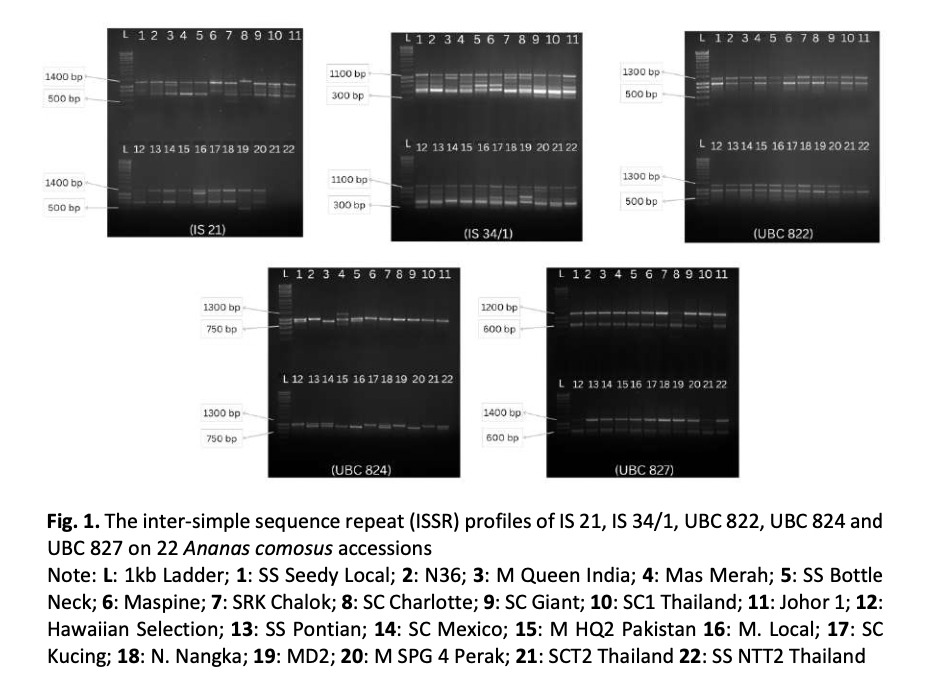
Pineapple is a member of Bromeliaceae family and a major tropical fruit crop with significant economic and nutritional importance globally. It contains high levels of vitamin C, sufficient to meet daily human requirements, making it is a highly nutritious fruit commonly consumed worldwide. However, the genetic diversity of pineapple accessions is not well-documented, hampering efforts to improve the crop through breeding programmes. Inter simple sequence repeat (ISSR) markers were used to assess the genetic diversity of 22 pineapple accessions obtained from MARDI Pontian. Five ISSR primers (IS21, IS34/1, UBC 822, UBC 824, UBC 827) amplified a total of 27 bands, of which 22 (81.5%) were polymorphic, with a mean Polymorphism Information Content of 1.236. ISSR primer IS21 and UBC 824 exhibited 100% polymorphism, whereas UBC 822 showed 60%. Jaccard’s similarity coefficient ranged from 0.333 to 0.850, indicating extremely high genetic diversity among pineapple accessions. Cluster analysis was conducted using the Unweighted Pair Group Method with Arithmetic Mean (UPGMA) to generate a dendrogram in NTSYS-pc software. The dendrogram based on UPGMA analysis grouped the 22 pineapple accessions into two main clusters. Cluster I comprised 21 accessions subdivided into two smaller clusters, whereas Cluster II contained a single accession. This study provides valuable data for utilizing genetic diversity in pineapple breeding and estimating heterosis. ISSR analysis proved to be an efficient method for assessing genetic variation, supporting both germplasm conservation, and breeding improvements.