SLE-RelapseX: Explainable and Causality-Aware Machine Learning for SLE Relapse Prediction
Keywords:
Systemic lupus erythematosus, relapse prediction, explainable machine learning, leakage-aware modelling, clinical decision supportAbstract
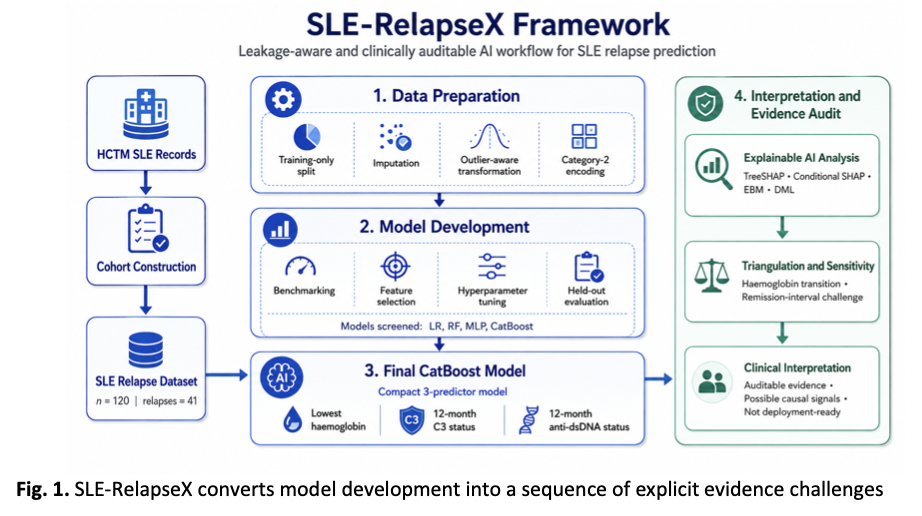
Systemic lupus erythematosus (SLE) relapse is clinically heterogeneous, and small prediction studies are vulnerable to leakage, correlated predictors and causal overinterpretation. This study addressed the lack of a compact relapse model accompanied by an explicit evidence audit. The objective was to develop and critically evaluate a leakage-aware machine-learning framework using routinely recorded variables. A retrospective cohort of 120 patients, including 41 relapses, was divided into 96 training and 24 held-out records. Preprocessing and feature selection were fitted only on training data. Logistic regression, random forest, multilayer perceptron and CatBoost were screened; the selected CatBoost model was evaluated using Shapley additive explanations (SHAP), an Explainable Boosting Machine (EBM), exploratory double machine learning (DML) and a remission-interval sensitivity analysis. The final model used lowest haemoglobin, complement component 3 (C3) status and anti-double-stranded DNA status. It produced precision 0.714, recall 0.625, specificity 0.875, accuracy 0.792 and an F1-score of 0.667. Standard and conditional SHAP preserved the same predictor ranking, while SHAP and EBM converged on a haemoglobin transition of 11.75-11.95 grams per decilitre. Exploratory DML found the strongest evidence compatible with a possible causal relationship for anti-double-stranded DNA positivity (estimate 0.426, 95% confidence interval 0.175-0.677; p<0.001), without establishing causation. Reintroducing remission interval reduced the F1-score to 0.429 and produced discordant thresholds. The framework therefore separates predictive performance, explanation robustness, exploratory causal evidence and leakage sensitivity. Prospective multicentre validation, calibration and clinical-utility assessment are required before deployment.