Deproteinised Natural Rubber (DPNR) Wear Phenomenon on Minimum Quantity Water Lubricated (MQWL) Conditioning Study
Keywords:
Tribology, DPNR, carbon black, MQWL, FEAAbstract
A Minimum Quantity Water Lubricated (MQWL) approach (0.0–10.6 ml) was applied to investigate the abrasive wear behaviour of deproteinised natural rubber (DPNR) under sliding conditions. Pin-on-disc (PoD) tests were conducted under controlled loads (5–25 N), sliding speeds (0.26–1.31 m/s), and sliding distances (78.54–392.70 m). The term critical operating condition refers to the highest stable load–speed combination at which continuous sliding was maintained without excessive specimen deflection or loss of contact. Catastrophic wear is defined as sudden material failure characterised by severe deformation, chunk detachment, and abrupt termination of the test. DPNR-25 (25 pphr. carbon black) reached its critical operating condition at 15 N and 0.79 m/s, whereas DPNR-50 (50 pphr. carbon black) withstood higher loading and exhibited catastrophic wear only at 25 N and 1.31 m/s. Under MQWL conditions, DPNR-25 showed a 30% improvement in wear resilience compared with its unlubricated baseline, while DPNR-50 exhibited a further 58% improvement relative to DPNR-25 under identical lubricated conditions, achieving a minimum specific wear rate of 0.05 mm³/N·m. Scanning electron microscopy (SEM) and energy-dispersive X-ray (EDX) analysis were used to elucidate wear mechanisms. Finite element analysis (FEA) was employed as a qualitative, tyre-scale simulation to assess deformation trends and safety margins under high load conditions, bridging laboratory-scale wear observations with realistic tyre operating scenarios.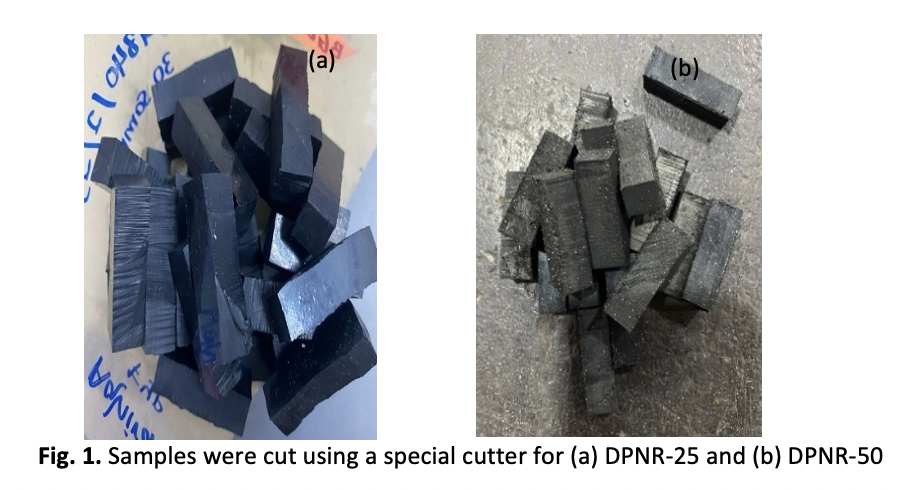
Downloads
Published
2026-06-08
How to Cite
Ramdziah Md. Nasir, Nur Aqhira A. Merican, & Muhamad Fitri Adnan. (2026). Deproteinised Natural Rubber (DPNR) Wear Phenomenon on Minimum Quantity Water Lubricated (MQWL) Conditioning Study . Semarak International Journal of Material Research, 6(1), 32–53. Retrieved from https://semarakilmu.my/index.php/sijmr/article/view/1134
Issue
Section
Articles