Study of Feasibility Assessment of Starting Transformer Operation Based on Analysis of Test Results at PLTU UP Gresik
Keywords:
Assessment kelayakan, starting transformer, insulation resistance, idissipation factor, sweep frequency response analysis, dielectric response analysis, PLTU GresikAbstract
Power transformers are critical components in generation systems that are susceptible to degradation in insulation quality and structural damage to windings due to prolonged operational loads. Starting Service Transformer (SST) #3-4 at PT PLN Nusantara Power Unit PLTU Gresik, which was built by Toshiba Corporation in 1978 with a capacity of 20. 000 kVA, has been in operation for more than 40 years so it requires a thorough evaluation before being allowed to operate again after the maintenance process. The purpose of this study is to identify the current state of the transformer, analyze the suitability of the test results with applicable technical standards, and provide recommendations on the feasibility of operation based on the available evidence. The method used was a mixture with a single descriptive case study design. Data was collected through direct observation in the field, semi-structured interviews with UMRO (Unit Maintenance, Repair, and Overhaul) technicians of PT PLN Nusantara Power, and analysis of FMH-17 report documents. 2. 4. 007. Seven types of electrical tests were conducted off-line from March 2 to 4, 2026, including Insulation Resistance and Polarization Index, Winding Resistance, Dissipaction Factor, Excitation Current, Sweep Frequency Response Analysis (SFRA), Dielectric Response Analysis (DIRANA), and Turn-to-Turn Ratio (TTR). The results of the tests showed that all eight parameters met the acceptance requirements set by IEEE C57. 152-2013, IEC 60422:2013, DL/T911-2004, and NCEPRI. The insulation system is in excellent condition, as evidenced by the moisture level of the insulation paper of 0.3% (well below the limit of 2.2%), the minimum IR value of 7.01 GΩ, and the Dissipation Factor value in UST mode of 0.138%. The structural integrity of the windings was confirmed to be normal through a deviation of winding resistance close to zero (0.000% of the HV side; 0.003% of the LV side), a good HLH excitation pattern, a uniform TTR deviation below 0.09%, as well as the results of the HV side SFRA showing Normal Winding based on the NCEPRI method. SST #3-4 was declared fit to operate again without the need for any prior repairs. The data from the SFRA test results is set as a benchmark for future overhaul.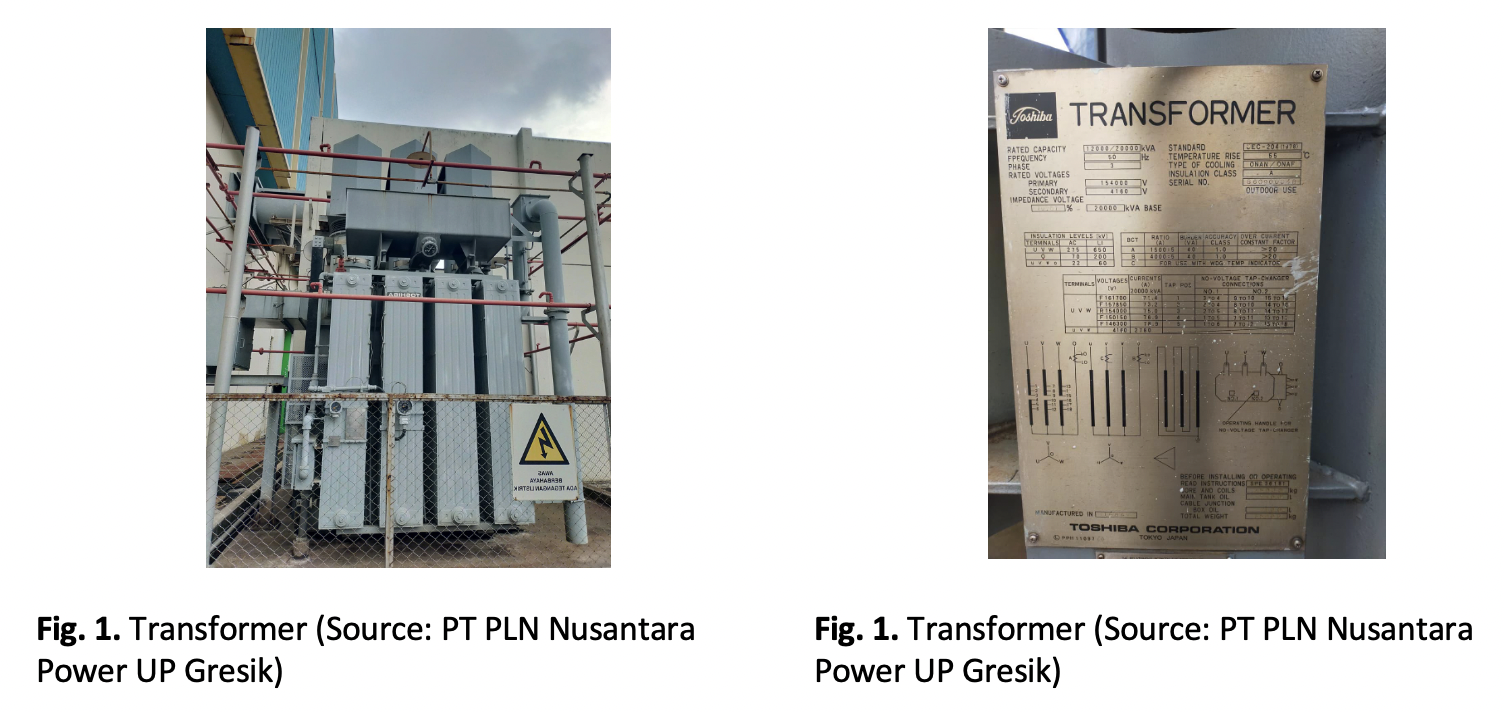
Downloads
Published
2026-07-16
How to Cite
Dhea Ananda Khusfita Sari, Ali Zainal Abidin, & Singgih Dwi Prasetyo. (2026). Study of Feasibility Assessment of Starting Transformer Operation Based on Analysis of Test Results at PLTU UP Gresik. Semarak International Journal of Mechanical Precision Engineering, 6(1), 1–22. Retrieved from https://semarakilmu.my/index.php/sijmpe/article/view/1163
Issue
Section
Articles