Enhancing Cybersecurity Competence through Experiential Lab-Based Learning: A Post-Survey Evaluation of the Cybersecurity Fundamentals Course in Malaysian TVET
Keywords:
Experiential learning, cybersecurity competence, TVET, digital ethics, workforce readiness, lab-based pedagogyAbstract
The rapid escalation of cyber threats has intensified the global demand for professionals who are not only technically competent but also ethically grounded. Addressing this need, the Cybersecurity Fundamentals course at Kolej Komuniti Pasir Salak, Malaysia, was designed as a fully lab-based experiential learning model emphasizing authentic, hands-on engagement with industry-standard tools. This study evaluates the effectiveness of that model in developing technical proficiency, ethical awareness, and learner engagement among Certificate in Information Technology students. A post-course quantitative survey involving 19 participants from the first cohort was conducted using a validated 4-point Likert-scale instrument covering engagement, tool mastery, and ethical understanding. Results indicated high overall satisfaction (mean = 3.28/4), with students reporting notable gains in applied competence and critical awareness of digital ethics. Qualitative responses further revealed that experiential learning improved confidence, problem-solving ability, and appreciation of real-world cybersecurity challenges. These findings provide empirical evidence that structured, lab-centered pedagogy significantly enhances the learning experience and workforce readiness of TVET students. The study contributes to the growing discourse on experiential cybersecurity education by offering a replicable model for skill-based learning that aligns with Malaysia’s Digital Economy Blueprint and global Industry 4.0 transformation goals.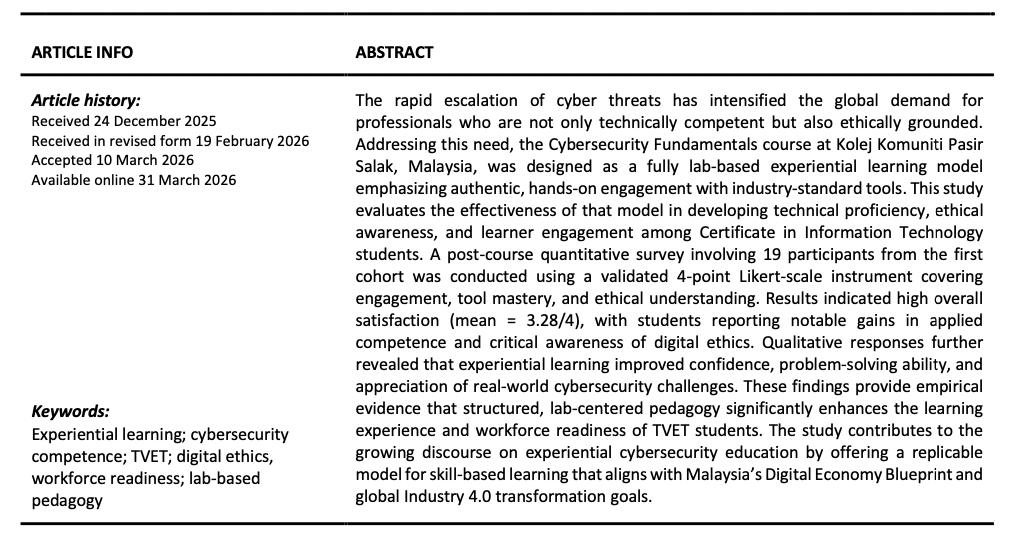
Downloads
Published
2026-04-01
How to Cite
Osmin, S. S., Darwish, T., & Mukri, M. (2026). Enhancing Cybersecurity Competence through Experiential Lab-Based Learning: A Post-Survey Evaluation of the Cybersecurity Fundamentals Course in Malaysian TVET. Semarak International Journal of Machine Learning, 9(1), 25–34. Retrieved from https://semarakilmu.my/index.php/sijml/article/view/1022
Issue
Section
Articles