
The Impact of Risk Perception, Locus of Control and Financial Literacy on Cryptocurrency Investment Intention Among Youth in Selangor

Authors

  • Sharmaine Nabeela Suhani Faculty of Business Management and Professional Studies, Management and Science University Shah Alam, Malaysia
  • Siti Fatimah Mohd Kassim Faculty of Business Management and Professional Studies, Management and Science University Shah Alam, Malaysia
  • Rami Basloom Faculty of Business Management and Professional Studies, Management and Science University Shah Alam, Malaysia
  • Muhammad Ahmad Faculty of Business Management and Professional Studies, Management and Science University Shah Alam, Malaysia
  • Zurin Shafii Universiti Sains Islam Malaysia, Nilai, Negeri Sembilan, Malaysia

Keywords:

Cryptocurrency, Risk Perception, Locus of Control, Financial Literacy, Youth Investors, Investment Intention, Digital Finance, Behavioural Finance, Emerging Markets

Abstract

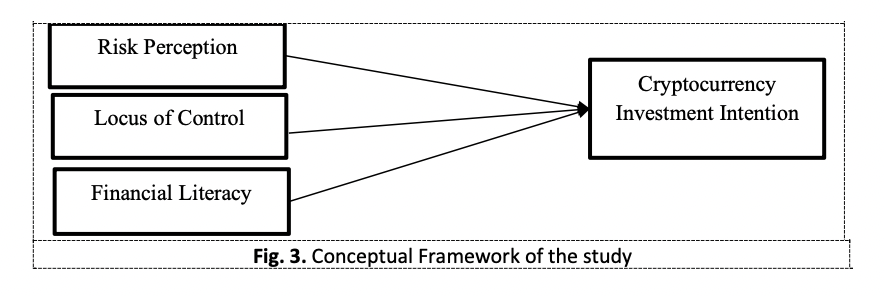
The rapid expansion of digital finance has transformed global investment behaviour, with cryptocurrency emerging as a widely discussed yet highly volatile financial instrument. Despite increasing global attention, cryptocurrency adoption among Malaysian youth remains relatively low, reflecting concerns related to risk, financial capability, and decision-making confidence. This study aims to examine the influence of risk perception, locus of control, and financial literacy on cryptocurrency investment intention among youth in Selangor. A quantitative cross-sectional research design is employed, and data are collected from 397 respondents using structured questionnaires. The data are analysed through descriptive statistics, correlation analysis, and multiple regression techniques to identify significant relationships among the variables. The findings reveal that all three factors significantly and positively influence cryptocurrency investment intention. Among these, financial literacy emerges as the most influential determinant, followed by locus of control and risk perception. The results indicate that Malaysian youth perceive cryptocurrency as both risky and potentially rewarding, and their willingness to invest is largely shaped by their financial knowledge, personal confidence, and ability to assess risk effectively. The study concludes that improving financial literacy and strengthening individual decision-making capabilities are essential for enhancing informed participation in digital financial markets. These findings provide important implications for policymakers, educators, and financial institutions in designing targeted financial education programs and regulatory strategies to support responsible cryptocurrency adoption among youth in Malaysia.

Author Biographies

Sharmaine Nabeela Suhani, Faculty of Business Management and Professional Studies, Management and Science University Shah Alam, Malaysia

Siti Fatimah Mohd Kassim, Faculty of Business Management and Professional Studies, Management and Science University Shah Alam, Malaysia

Rami Basloom, Faculty of Business Management and Professional Studies, Management and Science University Shah Alam, Malaysia

Muhammad Ahmad, Faculty of Business Management and Professional Studies, Management and Science University Shah Alam, Malaysia

Zurin Shafii, Universiti Sains Islam Malaysia, Nilai, Negeri Sembilan, Malaysia

Downloads

Published

2026-04-27

Issue

Section

Articles