Model Usahawan Sosial Asnaf Perlis: Satu Analisa
Perlis Asnaf Social Entrepreneur Model: An Analysis
Keywords:
Usahawan sosial asnaf, keusahawanan sosial Islam, Model MUSAB, ATAM, transformasi ekonomi, negeri Perlis, Asnaf social entrepreneurs, Islamic social entrepreneurship, MUSAB Model, economic transformation, Perlis stateAbstract
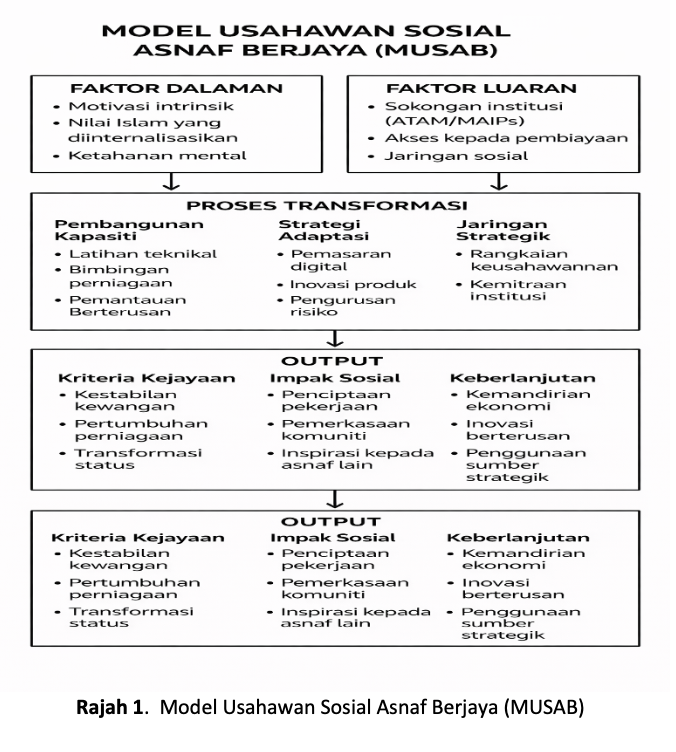
Artikel ini bertujuan untuk membangunkan Model Usahawan Sosial Asnaf Berjaya (MUSAB) dengan mengenal pasti faktor-faktor kritikal yang menyumbang kepada kejayaan usahawan dalam kalangan golongan asnaf di Negeri Perlis. Walaupun inisiatif keusahawanan sosial semakin mendapat perhatian sebagai mekanisme transformasi ekonomi, pembentukan model khusus bagi usahawan asnaf. Golongan asnaf sering menghadapi halangan yang kompleks termasuk kekurangan modal, kemahiran, dan stigma sosial, yang memerlukan pendekatan bersepadu untuk memastikan keberkesanan program pembangunan keusahawanan. Di samping itu, kajian kualitatif telah direka dengan bentuk fenomenologi telah dijalankan. Data dikumpulkan melalui temu bual separa berstruktur bersama empat informan yang terdiri daripada pegawai ATAM dan usahawan asnaf yang berjaya. Data dianalisis menggunakan analisis tematik dengan bantuan perisian ATLAS.ti 24 untuk mengenal pasti tema-tema utama yang berkaitan dengan pengalaman, amalan, dan cabaran usahawan. Tegasnya, dapatan kajian mendapati bahawa kejayaan usahawan sosial asnaf dipengaruhi secara signifikan oleh faktor dalaman (kesungguhan, komitmen, disiplin) dan faktor luaran (sokongan institusi seperti ATAM dan MAIPs, latihan kemahiran, bantuan modal, dan pemantauan berterusan). Berdasarkan dapatan ini, Model MUSAB telah dibangunkan dengan lima elemen teras: (1) kriteria kejayaan, (2) cabaran utama, (3) impak program dan pemantauan, (4) impak sosial dan komuniti, dan (5) keberlanjutan dan masa depan. Secara keseluruhannya, kajian ini menyumbang kepada bidang keusahawanan sosial Islam dengan memperkenalkan Model MUSAB yang mengintegrasikan nilai-nilai Islam dengan sokongan institusi yang sistematik. Model ini berpotensi dijadikan sebagai kerangka rujukan oleh institusi zakat dan agensi pembangunan usahawan dalam merangka program yang lebih efektif untuk memberdayakan golongan asnaf. Kerjasama strategik antara institusi zakat, agensi kerajaan, dan sektor swasta juga perlu diperkukuh untuk memastikan kelestarian program keusahawanan asnaf.
This article aims to develop a Successful Asnaf Social Entrepreneur Model (MUSAB) by identifying critical factors that contribute to the success of entrepreneurs among the asnaf group in the State of Perlis. Although social entrepreneurship initiatives are increasingly gaining attention as a mechanism for economic transformation, the formation of a specific model for asnaf entrepreneurs. The asnaf group often faces complex obstacles including lack of capital, skills, and social stigma, which requires an integrated approach to ensure the effectiveness of entrepreneurial development programs. In addition, a qualitative study was designed with a phenomenological form was conducted. Data was collected through semi-structured interviews with four informants consisting of ATAM officers and successful asnaf entrepreneurs. The data was analyzed using thematic analysis with the help of ATLAS.ti 24 software to identify key themes related to the experiences, practices, and challenges of entrepreneurs. Specifically, the study findings found that the success of asnaf social entrepreneurs is significantly influenced by internal factors (seriousness, commitment, discipline) and external factors (institutional support such as ATAM and MAIPs, skills training, capital assistance, and continuous monitoring). Based on these findings, the MUSAB Model was developed with five core elements: (1) success criteria, (2) key challenges, (3) program impact and monitoring, (4) social and community impact, and (5) sustainability and future. Overall, this study contributes to the field of Islamic social entrepreneurship by introducing the MUSAB Model that integrates Islamic values with systematic institutional support. This model has the potential to be used as a reference framework by zakat institutions and entrepreneur development agencies in designing more effective programs to empower the asnaf group. Strategic collaboration between zakat institutions, government agencies, and the private sector also needs to be strengthened to ensure the sustainability of asnaf entrepreneurship programs.