From Welfare Beneficiaries to Agents of Change: Explaining Transformative Social Value through Theory of Change and Social Return on Investment in Disability-Inclusive CSR
Keywords:
Social Return on Investment (SROI), attribution, impact measurement, Theory of Change, social valueAbstract
The evolution of the inclusive development paradigm underscores the urgency of engaging vulnerable groups, particularly persons with disabilities (PwDs) to create equitable socio-economic systems. Employing a value-benefit transfer approach and structural shift analysis through a Theory of Change (ToC) lens, this study evaluates how the social return on investment (SROI) and ecological circular economy integration of a disability-inclusive CSR initiative, the "Berbisik" program by PT Patra Niagar Refinery Unit VI Balongan, can be rigorously assessed. The findings demonstrate that the program generated a robust SROI ratio of 1.87, meaning that every Rp 1 invested yielded Rp 1.87 in combined social and economic value. Furthermore, this initiative triggered a profound social transformation that extended far beyond individual skill enhancement, driving changes across the seven-capital framework, specifically strengthening human, social, institutional, economic, and environmental capitals that collectively reflect a comprehensive, multidimensional impact. This study offers a vital theoretical contribution by redefining marginalized disabled communities as active agents of social change rather than passive welfare beneficiaries. Operationally, it establishes a highly replicable corporate sustainability framework, demonstrating that integrating disability inclusion with circular economy practices yields quantifiable, high-value social returns, thereby offering a strategic roadmap for policymakers and global enterprises aiming to achieve genuine, long-term sustainable development goals (SDGs).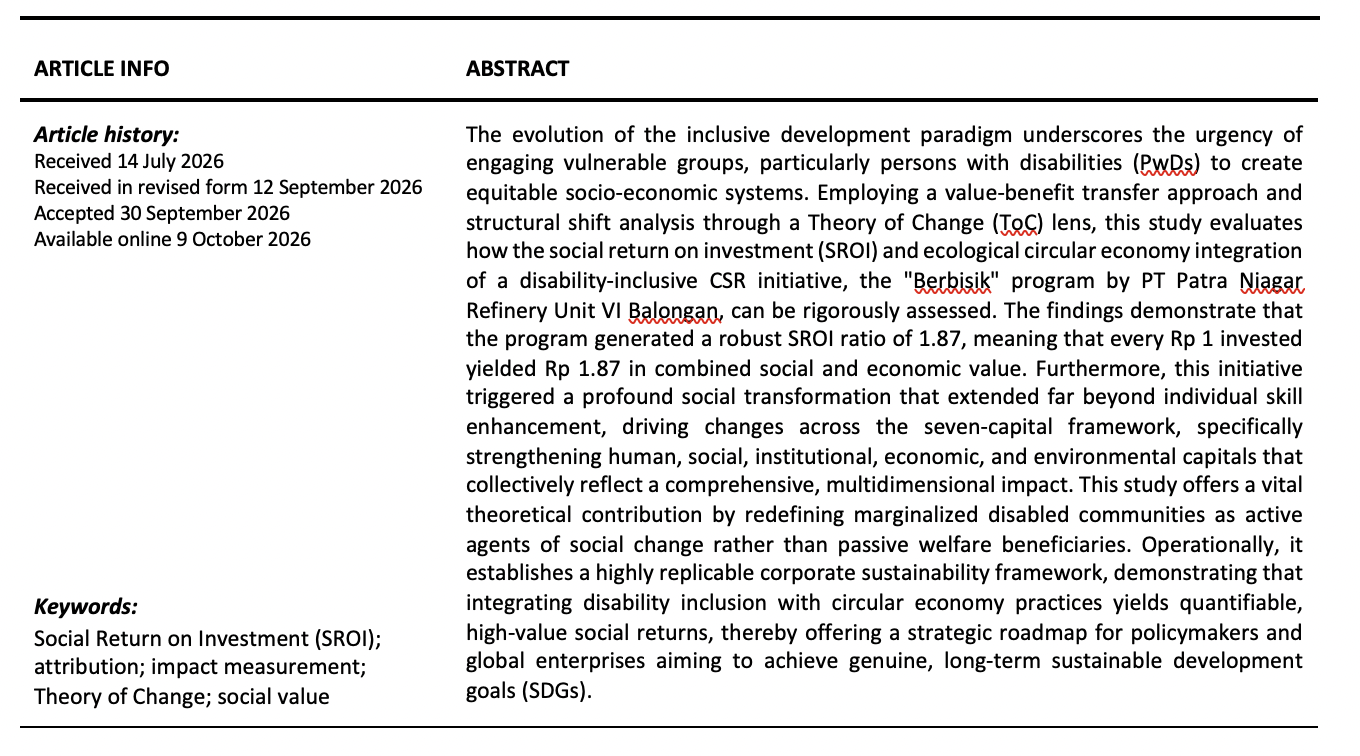
Downloads
Published
2026-10-09
How to Cite
Andromedo Cahyo Purnomo, Reza Faidhil Fitriansyah, Nur Wahyu May Alfian, & Bonifasius Santiko Parikesit. (2026). From Welfare Beneficiaries to Agents of Change: Explaining Transformative Social Value through Theory of Change and Social Return on Investment in Disability-Inclusive CSR . Semarak International Journal of Entrepreneurship, Economics, and Business Development , 9(1), 11–24. Retrieved from https://semarakilmu.my/index.php/sijeebd/article/view/1230
Issue
Section
Articles