Institutional Constraint Systems in Inclusionary Zoning: Why Transit-Oriented Development Integration Fails
Keywords:
Inclusionary zoning, transit-oriented development, institutional constraints, land administration and developmentAbstract
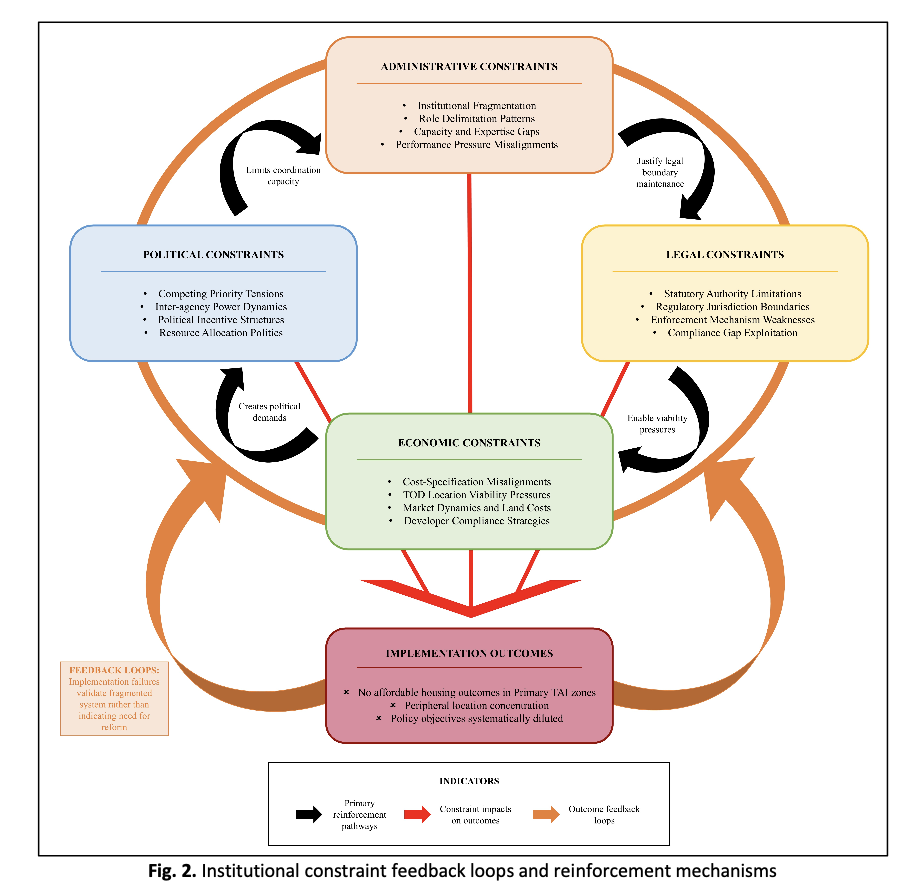
Despite widespread adoption globally, inclusionary zoning (IZ) policies frequently struggle to achieve spatial integration of affordable housing within transit-oriented development (TOD) areas, even where planners explicitly target these locations to maximize accessibility benefits for lower-income households. Existing scholarship documents numerous implementation barriers but examines them separately, obscuring how administrative, legal, economic, and political constraints may interact to create self-reinforcing systems resistant to incremental reform. Drawing on institutional analysis framework and comparative case studies of Kuala Lumpur's voluntary incentive-based and Selangor's mandatory requirement-based IZ programs in Malaysia, this paper asks: How do institutional constraints interact as systems to explain persistent IZ-TOD integration failures across policy models? Analysis of interviews with 24 stakeholders from planning authorities, housing agencies, and private developers reveals that constraints appear to operate not independently but through four primary reinforcement pathways. Institutional fragmentation justifies legal boundary maintenance, which enables economic viability pressures through enforcement gaps, which generates political demands for flexibility, which limits administrative coordination capacity, thereby perpetuating fragmentation. Implementation failures tend to validate rather than challenge these fragmented arrangements, creating dynamic equilibrium. This constraint system framework advances institutional theory by demonstrating how multiple constraint types may compound through interconnection mechanisms that generate barriers exceeding individual constraints' effects. The analysis reveals broadly similar patterns across voluntary and mandatory models, suggesting that implementation failures reflect fundamental features of fragmented housing governance rather than merely correctable policy design flaws. Effective IZ-TOD integration likely requires comprehensive institutional restructuring simultaneously addressing coordination capacity, legal frameworks, economic feasibility, and political incentive structures rather than sequential reforms to isolated dimensions.