The Effectiveness of the I See, I Think, and I Wonder (ISITIW) Method in Assessing Arabic Vocabulary Mastery among Arabic Language Teachers and Secondary School Students
Keywords:
I see I think I wonder, Arabic language teaching, vocabulary mastery, student engagement, critical thinkingAbstract
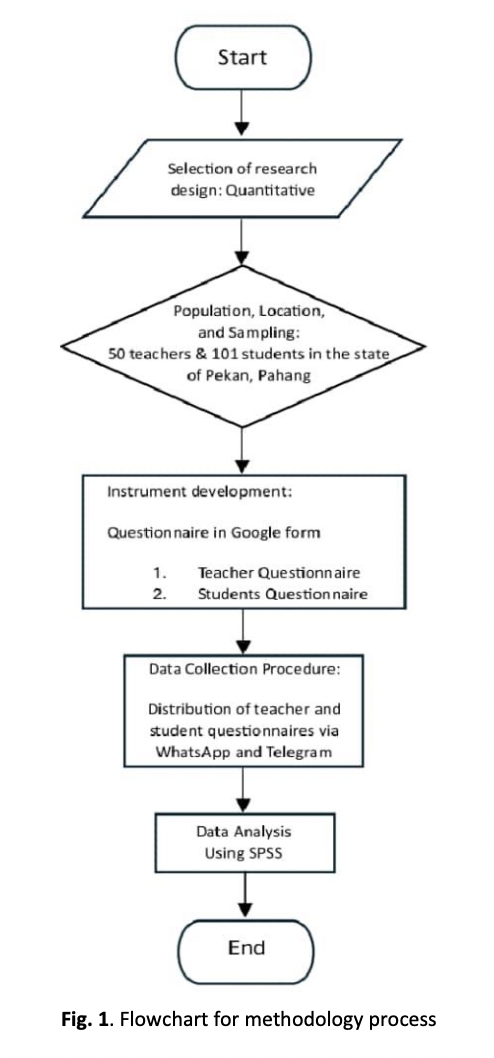
This study investigates the effectiveness of the I See, I Think, I Wonder (ISITIW) strategy as a 21st-century learning approach in Arabic language education for secondary school students. Although ISITIW is widely recognized as a visible thinking routine that promotes observation, interpretation, and inquiry, its application in Arabic classrooms remains limited. To address this gap, a quantitative survey design was employed involving 50 Arabic language teachers and 101 students from secondary schools in Pahang. Data were collected using two structured questionnaires on a five-point Likert scale and analyzed with SPSS to generate descriptive statistics. The research focused on three aspects: the effectiveness of ISITIW in improving vocabulary acquisition, its role in promoting active participation and critical thinking, and perceptions of its practicality and suitability for diverse proficiency levels. Findings revealed strong positive responses from both teachers and students. Results show that teachers rated the strategy highly for improving vocabulary mastery (M = 4.2760), promoting active engagement (M = 4.1533), and supporting comprehension of topics (M = 4.3000). Similarly, students agreed on its effectiveness for vocabulary mastery (M = 4.0759), active engagement (M = 4.0429), and understanding lesson content (M = 4.2698). High mean scores across engagement-related items confirm that ISITIW fosters active participation and higher-order thinking, aligning with principles of learner-centered pedagogy and inquiry-based learning. Overall, ISITIW demonstrates significant pedagogical value as a practical and adaptable strategy for Arabic language instruction. By encouraging observation, interpretation, and questioning, the method not only strengthens vocabulary acquisition but also promotes metacognitive development and collaborative learning. The study concludes that ISITIW is an effective and learner-centered approach that enhances teaching and learning outcomes in Arabic language education. It recommends broader integration of ISITIW into Arabic classrooms and suggests future research to explore its impact on other linguistic skills, such as reading comprehension and writing, as well as its long-term effect on vocabulary retention.