Mapping the Therapeutic Potential of Persicaria minor Phytochemicals Against Oxidative Stress: A Target-Centric Network Approach
Keywords:
Persicaria minor, oxidative stress, network pharmacology, antioxidant compounds, in-silico analysisAbstract
Oxidative stress underlies the pathogenesis of chronic disorders through the dysregulation of redox-sensitive signalling. Yet, the molecular mechanisms underlying the antioxidant capacity of Persicaria minor remain poorly understood. This study integrated pharmacokinetic filtering, target prediction, and topological network analysis to elucidate the systems-level antioxidant mechanisms of P. minor. Among 143 reported phytoconstituents, 27 exhibited favourable oral bioavailability and interacted with 152 oxidative stress–related targets. Network metrics identified isorhamnetin, feruloyltyramine, and radiclonic acid as central bioactives targeting key regulators including NOX4, XDH, and CA2 (degree ≥ 30). Functional enrichment revealed modulation of the PI3K–AKT, MAPK, and p53 pathways—central nodes of the oxidative stress response. These findings provide mechanistic insights into P. minor’s redox-modulatory potential and position it as a promising candidate for the development of multi-target antioxidant therapeutics.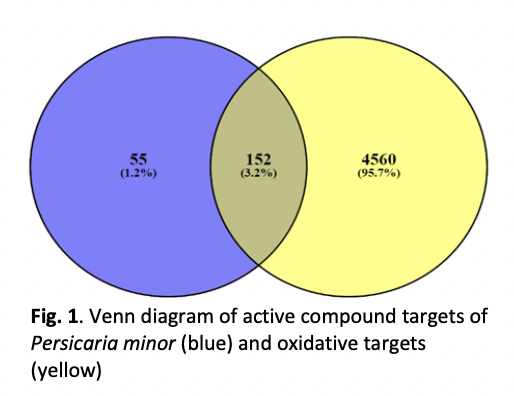
Downloads
Published
2025-12-08
How to Cite
Misnan, A. K., Yob, N. J., & Mohamed, R. (2025). Mapping the Therapeutic Potential of Persicaria minor Phytochemicals Against Oxidative Stress: A Target-Centric Network Approach. Semarak International Journal of Chemical Process Engineering, 5(1), 27–39. Retrieved from https://semarakilmu.my/index.php/sijcpe/article/view/890
Issue
Section
Articles