Design of a Solar-Powered Esp32-Based Automatic Fish Feeding System for Sustainable Small-Scale Aquaculture
Keywords:
Automatic Fish Feeder, Solar Energy, ESP32, Aquaculture, Photovoltic System, Renewable EnergyAbstract
Efficient feed management is an important part of small-scale aquaculture because feeding that is not properly controlled can result in excessive feed use and unnecessary wast. This study presents the design of a solar-powered automatic fish feeding system for pond and tank aquaculture. The system is designed to provide fish feed at scheduled times while reducing dependence on grid electricity, particulary in areas with limited access to electrical infrastructure. The proposed system consists of a 30 Wp photovoltaic panel, a 12 V 7 Ah sealed lead-acid (SLA) battery, a PWM solar charge controller, an ESP32 microcontroller, an MG996R servo motor, and an I2C LCD. The photovoltaic panel serves as the main energy source and charges the battery through the solar charge controller. The stored energy is then used to operate the control and feeding schedule and controls the servo motor to open and close the feed dispenser according to the programmed settings. The system was developed using an engineering research approach involving system design, component assembly, and functional evaluation. Based on the system design, the estimated energy consumption is approximately 3.6 Wh per day, allowing the system to operate with renewable energy demand. The proposed design combines automatic feeding with renewable energy, providing a practical alternative for small-scale aquaculture operations, especially in locations where access to grid electricity is limited.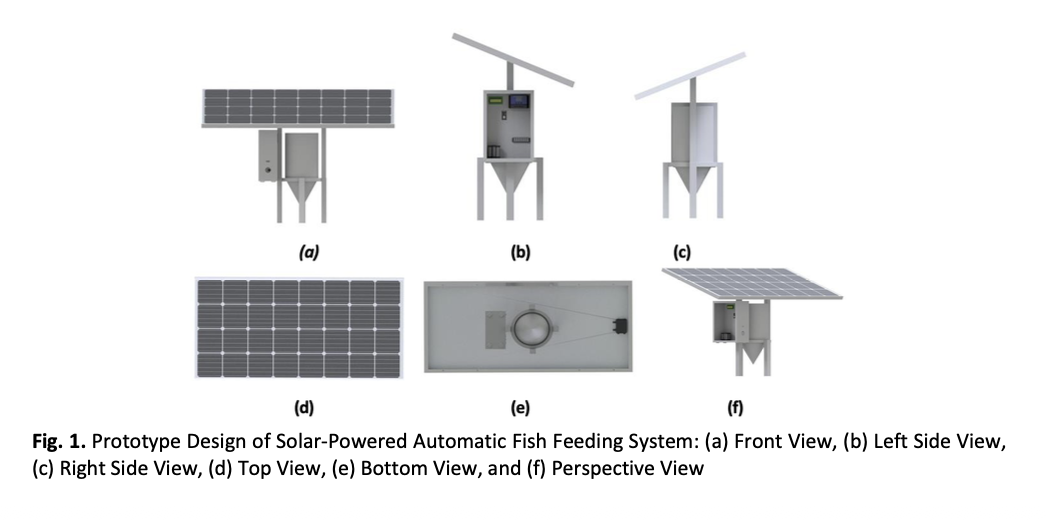
Downloads
Published
2026-11-05
How to Cite
Iltizamul Haqqi, Devina Aprillia, & Dava Maulana Yudha. (2026). Design of a Solar-Powered Esp32-Based Automatic Fish Feeding System for Sustainable Small-Scale Aquaculture. Semarak International Journal of Animal Sciences and Zoology, 6(1), 1–7. Retrieved from https://semarakilmu.my/index.php/sijasz/article/view/1254
Issue
Section
Articles