
Fingerprint Based Electronic Voting System for University Students

Authors

  • Abdelrahman I.A. Alnashar Department of Information Sciences and Engineering, Faculty of Information Sciences and Engineering, Management and Science University, 40100 Shah Alam, Selangor, Malaysia
  • Nurul Qusna Mohd Zaki Department of Information Sciences and Engineering, Faculty of Information Sciences and Engineering, Management and Science University, 40100 Shah Alam, Selangor, Malaysia
  • Ahgalya Subbiah Department of Information Sciences and Engineering, Faculty of Information Sciences and Engineering, Management and Science University, 40100 Shah Alam, Selangor, Malaysia

Keywords:

Electronic voting system, biometric authentication, fingerprint recognition, firebase database, software security

Abstract

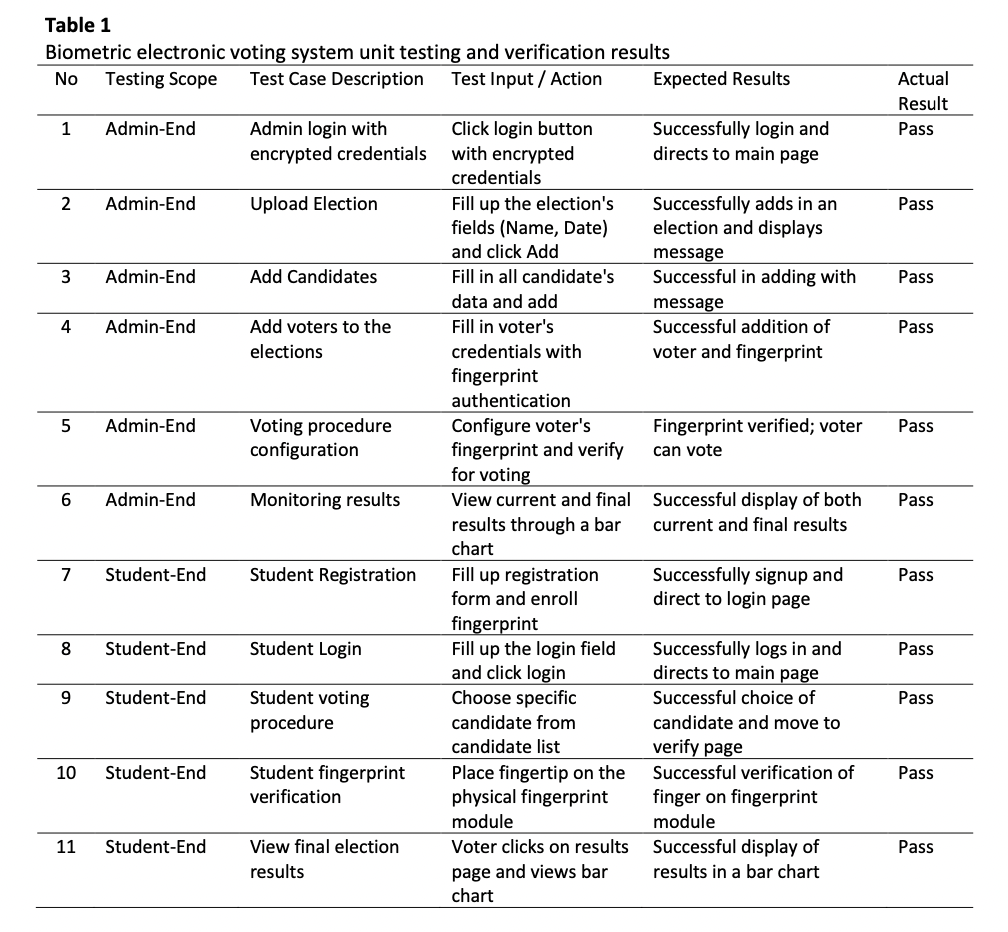
Traditional university student elections often rely on paper-based ballots that are inefficient and susceptible to manipulation or voter impersonation. This study addresses these vulnerabilities by developing a secure, fingerprint-based electronic voting system (EVS) specifically tailored for campus environments. The purpose of this research is to modernize student elections, guaranteeing that each vote is unique, traceable, and secure throughout the electoral process. Adopting a structured five-phase waterfall software engineering methodology, the system is designed with Java (NetBeans Swing) for the graphical interfaces and Firebase for a real-time, synchronized database. Rigorous unit testing was conducted on both the administrator and student interfaces to evaluate functional correctness, security compliance, and latency. The principal results demonstrate 100% operational success across all critical unit test cases, including secure credential login, biometric template enrollment, real-time ballot casting, and dynamic bar-chart visualization of results. This study concludes that integrating fingerprint recognition with synchronized cloud databases successfully eliminates double voting and ballot tampering, paving the way for a more transparent, efficient, and accessible democratic process in higher education institutions.

Author Biography

Ahgalya Subbiah, Department of Information Sciences and Engineering, Faculty of Information Sciences and Engineering, Management and Science University, 40100 Shah Alam, Selangor, Malaysia

ahgalya_subbiah@msu.edu.my 

Downloads

Published

2026-10-14

Issue

Section

Articles