

Long-Term Forecasting of Hydropower Generation and Electricity Demand using Artificial Neural Networks: Energy Gap Analysis between the Wlingi Hydropower Plant and Electricity Demand in Blitar Regency, Indonesia

Authors

  • Saika Khoolish Rochma Fa'alih Power Plant Engineering Technology, Faculty of Vocational Studies, State University of Malang, Malang 65145, Indonesia
  • Ibrahim Fahmi PT. Pelindo Energi Logistik, Jl. Perak Timur No. 610, Surabaya 60164, Indonesia
  • Singgih Dwi Prasetyo Power Plant Engineering Technology, Faculty of Vocational Studies, State University of Malang, Malang 65145, Indonesia

Keywords:

Hydropower, climate change, energy forecasting, artificial neural network, renewable energy resilience

Abstract

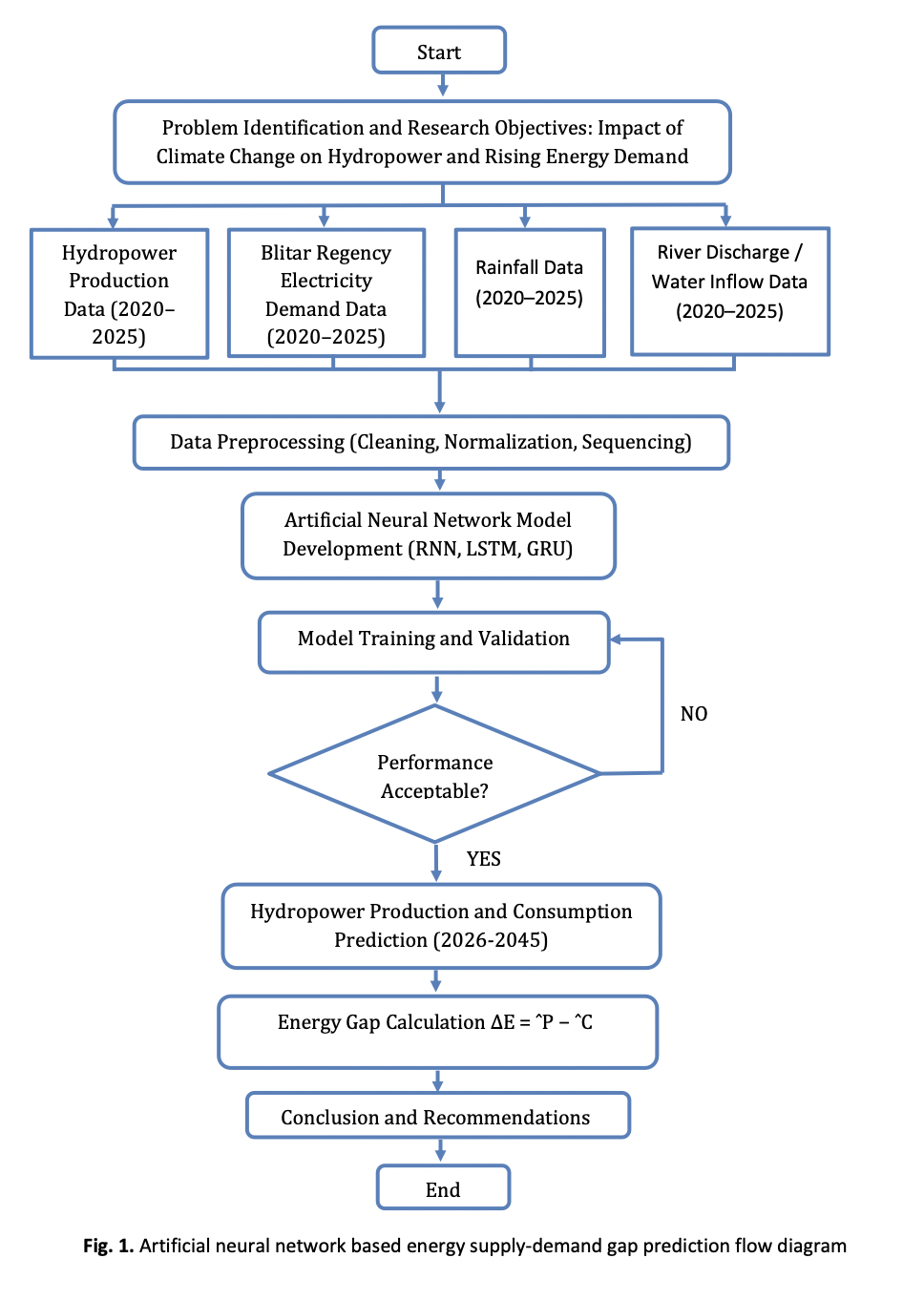
This study investigates the long-term structural electricity production–consumption gap under climate-induced hydrological variability, focusing on the Wlingi Hydroelectric Power Plant and Blitar Regency, Indonesia. Using historical operational and hydro-meteorological data from 2020–2025 as baseline input, three Artificial Neural Network (ANN) architectures Recurrent Neural Networks (RNN), Long Short-Term Memory (LSTM), and Gated Recurrent Units (GRU) are comparatively evaluated to forecast electricity production, demand growth, and the resulting energy deficit over the 2026–2045 horizon. The predictive simulation reveals a progressively widening structural gap, expanding from approximately −427 GWh in 2026 to nearly −1,668 GWh in 2045, driven by exponential regional demand escalation and gradual hydropower performance degradation linked to global warming induced river discharge instability. While historically contributing 25%–37% of regional electricity demand, the hydropower fulfillment ratio is projected to decline to below 8% by 2045, indicating a substantial erosion of local renewable energy autonomy. Computational evaluation confirms that LSTM and GRU exhibit superior robustness and long-term dependency modeling compared to conventional RNN, particularly under stochastic hydro-climatic conditions. The novelty of this research lies in integrating climate-driven hydrological uncertainty into ANN based energy gap forecasting for operational hydropower systems. The findings underscore the vulnerability of climate-dependent renewable infrastructure and highlight the urgency of climate-adaptive energy diversification and storage integration strategies to sustain regional grid resilience under accelerating global warming pressures.

Author Biography

Singgih Dwi Prasetyo, Power Plant Engineering Technology, Faculty of Vocational Studies, State University of Malang, Malang 65145, Indonesia

singgih.prasetyo.fv@um.ac.id

Downloads

Published

2026-05-17

Issue

Section

Articles