Analysis of Solar Energy Utilization on Electric Bicycles as an Energy Source for Automatic Fertilizer Spreading Systems for Agricultural Applications
Keywords:
Solar energy, electric bicycle, automatic fertilizer spreading, agricultural technology, renewable energyAbstract
The agricultural sector requires technological innovations capable of improving operational efficiency while supporting the utilization of renewable energy. Fertilization is one of the essential activities in the cultivation process, which is generally still carried out manually, requiring considerable labor and potentially resulting in uneven fertilizer distribution. This study proposes an innovation of an automatic fertilizer spreading system integrated with an electric bicycle and powered by solar panels as a more efficient and sustainable technological alternative. The innovation utilizes photovoltaic panels as an energy source to supply the power requirements of the fertilizer spreading system, with a battery serving as an energy storage medium, allowing the generated energy to be used to operate the automatic fertilizer spreading mechanism. The system is integrated into an electric bicycle as a mobile platform, enabling the fertilization process to be carried out more practically across agricultural areas. The methodology employed is a Systematic Literature Review (SLR) to identify and synthesize previous studies related to the utilization of solar energy in electric vehicles, energy storage systems, automatic fertilizer spreading mechanisms, and agricultural automation technologies. The selected literature is analyzed to assess the potential of solar energy, the energy requirements of the fertilizer spreading system, and the feasibility of integrating solar panels, batteries, an electric bicycle, and an automatic fertilizer spreading mechanism. The expected outcome is a conceptual analysis of the performance and potential utilization of solar energy as an energy source for an automatic fertilizer spreading system integrated with an electric bicycle, including its suitability for supporting agricultural fertilization activities. This innovation is expected to improve the efficiency of the fertilization process, reduce dependence on manual labor and conventional energy sources, and promote the application of renewable energy in agricultural technology. Thus, the proposed system has the potential to serve as an automatic, mobile, energy-efficient, and sustainable agricultural technology solution.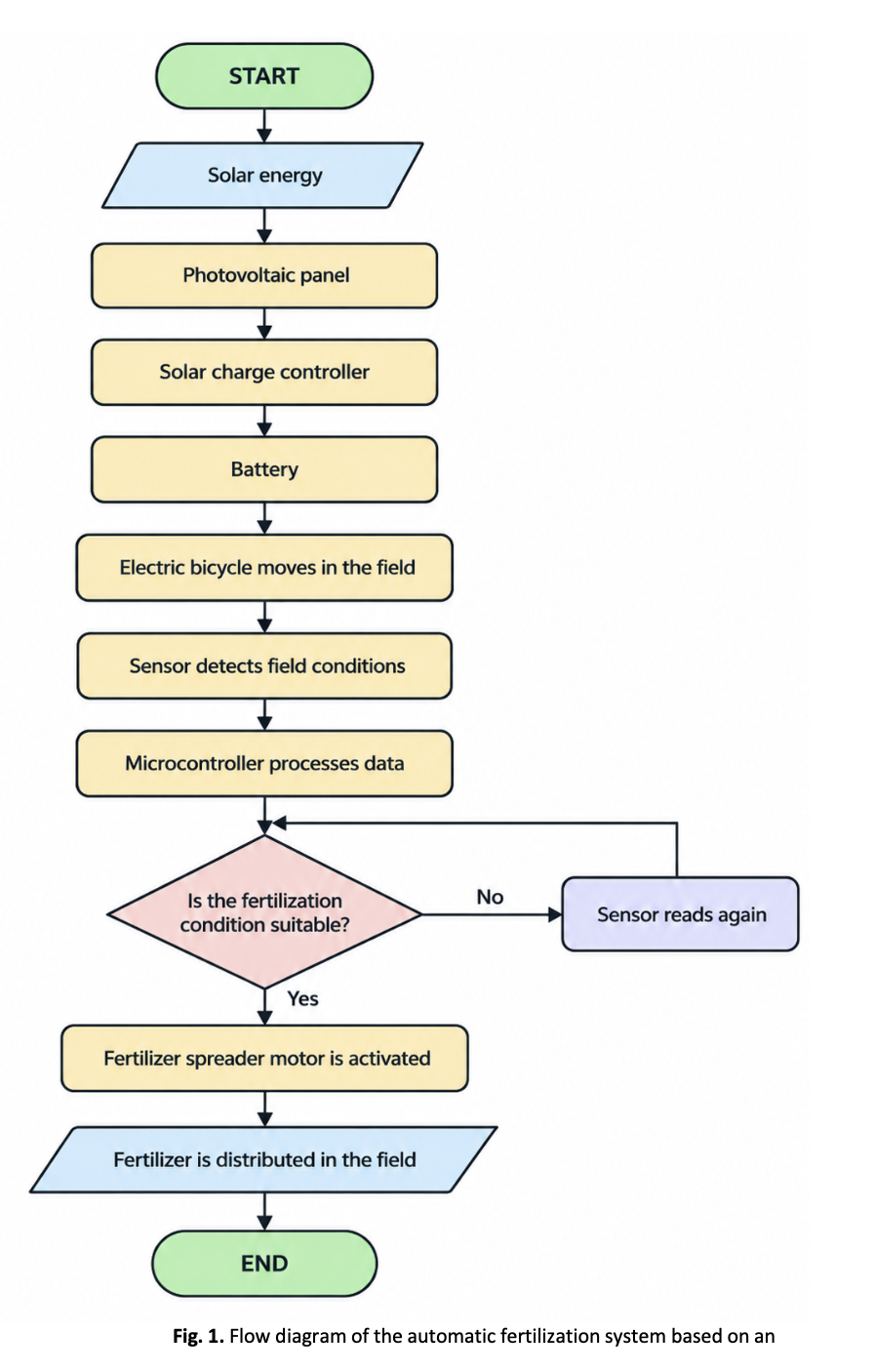
Downloads
Published
2026-10-17
How to Cite
Sheila Reinanda Putri, Yashinta Naila Evi Nastiti, Yurike Dwi Oktavia, Olivia Susanto, & Singgih Dwi Prasetyo. (2026). Analysis of Solar Energy Utilization on Electric Bicycles as an Energy Source for Automatic Fertilizer Spreading Systems for Agricultural Applications. Semarak International Journal of Agriculture, Forestry and Fisheries , 9(1), 1–15. Retrieved from https://semarakilmu.my/index.php/sijaff/article/view/1247
Issue
Section
Articles