Engineering-Oriented Mitigation and System Optimization of Occupational Safety Risks in Textile Manufacturing using Grey DEMATEL
DOI:
https://doi.org/10.37934/sej.12.1.177195Keywords:
Engineering-oriented safety mitigation, system optimization, occupational safety risks, Grey DEMATEL, textile manufacturingAbstract
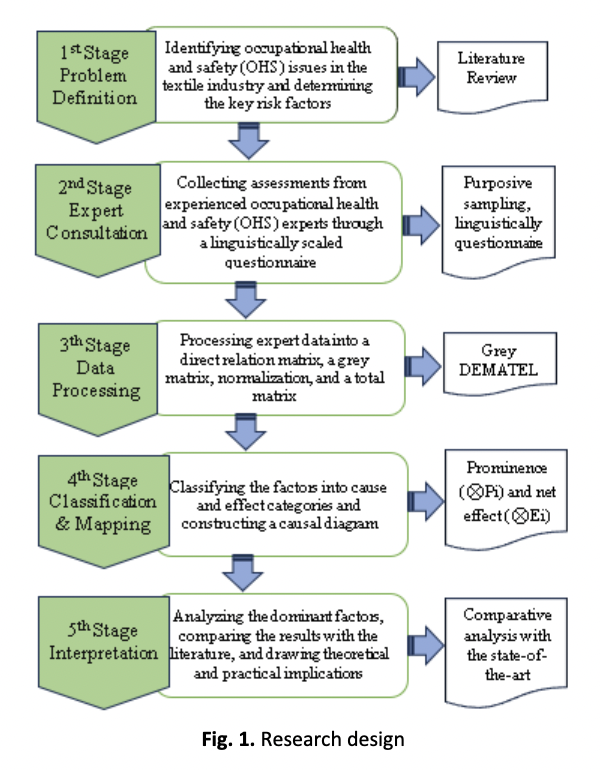
Occupational safety risk management in textile manufacturing has predominantly relied on descriptive evaluations and administrative measures, which often fall short in supporting engineering-based decision-making and system-level interventions. To address this limitation, the present study introduces an engineering-oriented framework for occupational safety risk mitigation and system optimization by integrating the Grey Decision-Making Trial and Evaluation Laboratory (Grey DEMATEL) method to analyze causal relationships among safety risk factors. The Grey DEMATEL technique is applied to accommodate uncertainty in expert judgments while enabling the identification of key causal drivers that can serve as leverage points for engineering controls and process redesign. Drawing on evaluations by 12 experts in occupational safety and engineering, this study assesses 25 safety risk factors in textile manufacturing operations. It structures them into a comprehensive causal network. The analysis identifies ten dominant causal factors, including the operation of electrical equipment in wet environments, improper chemical storage practices, manual material handling without mechanical assistance, insufficient fire detection systems, and procedural weaknesses affecting system performance. These factors demonstrate high prominence and positive net influence values, indicating their significant role in triggering and amplifying secondary risks, including excessive noise exposure, chemical hazards, airborne dust, and worker fatigue. Moving beyond conventional risk identification, the study translates analytical findings into engineering-based mitigation strategies, encompassing process redesign, equipment modification, and system-level safety interventions. The results illustrate the effectiveness of Grey DEMATEL as a decision-support tool for prioritizing engineering controls, enabling risk reduction at the source of hazard generation. From an engineering standpoint, the proposed framework facilitates the development of sustainable, measurable, and integrated safety solutions tailored to labor-intensive manufacturing environments.