
Process Engineering and Techno-Economic Assessment of Plastic Waste Pyrolysis for Liquid Fuel Production in Tourism-Based Geopark Systems

Authors

  • Rita Rahmawati Department of Public Administration, Faculty of Social and Political Sciences, Universitas Djuanda, Bogor, Indonesia
  • Martin Roestamy Department of Law, Faculty of Law, Universitas Djuanda, Bogor, Indonesia
  • Faisal Tri Ramdani Department of Public Administration, Faculty of Social and Political Sciences, Universitas Djuanda, Bogor, Indonesia
  • Irma Purnamasari Department of Public Administration, Faculty of Social and Political Sciences, Universitas Djuanda, Bogor, Indonesia
  • Sri Harini Department of Management, Faculty of Economics and Business, Universitas Djuanda, Bogor, Indonesia
  • Ginung Pratidina Department of Public Administration, Faculty of Social and Political Sciences, Universitas Djuanda, Bogor, Indonesia
  • Awa Awa Department of Management, Faculty of Economics and Business, Universitas Djuanda, Bogor, Indonesia
  • Warizal Warizal Department of Accounting, Faculty of Economics and Business, Universitas Djuanda,Bogor, Indonesia

DOI:

https://doi.org/10.37934/sej.12.1.163176

Keywords:

Plastic, Pyrolysis, Sustainable energy systems, Techno-Economy, Waste of Tourism

Abstract

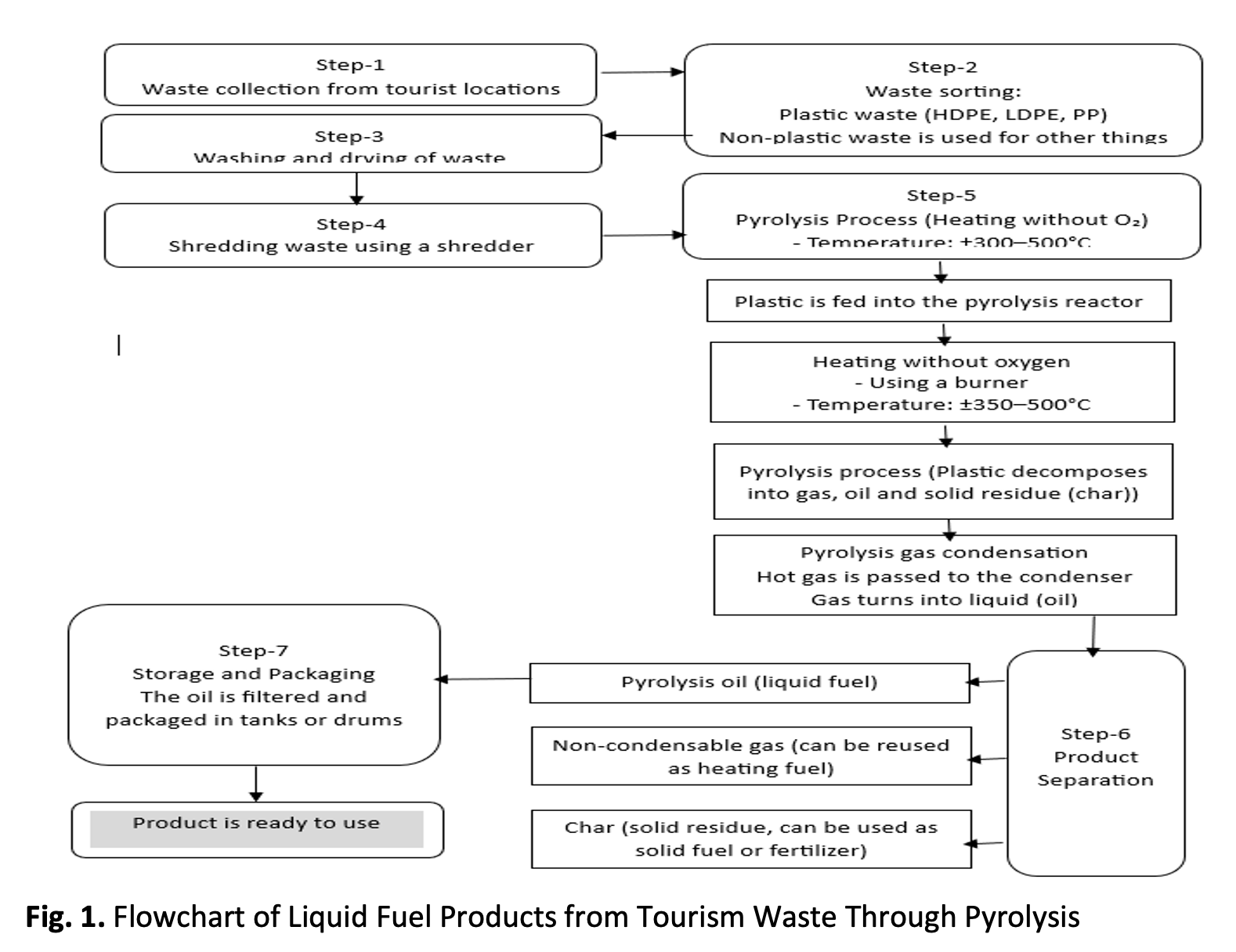
This study presents a process engineering and techno-economic assessment of liquid fuel production from tourism-generated plastic waste using a pyrolysis-based conversion system implemented in geopark environments. The proposed system integrates waste collection and preprocessing, oxygen-limited thermal decomposition, and condensation-based product recovery to transform plastic waste into a usable liquid fuel. The engineering assessment evaluates system operability, feedstock handling, and energy recovery pathways, including the utilization of by-products to enhance overall process efficiency. A techno-economic framework is applied to examine investment feasibility, operational robustness, and long-term financial performance under realistic implementation conditions. The results indicate that plastic waste pyrolysis can function as a viable waste-to-energy solution in tourism-intensive geopark systems when supported by effective operational management and institutional coordination. Beyond economic performance, the system contributes to circular resource utilization, waste reduction, and local energy generation. The proposed approach directly supports the Sustainable Development Goals (SDGs), particularly those related to affordable and clean energy, sustainable communities, responsible consumption and production, and climate action.

Author Biographies

Rita Rahmawati, Department of Public Administration, Faculty of Social and Political Sciences, Universitas Djuanda, Bogor, Indonesia

rita.rahmawati@unida.ac.id

Martin Roestamy, Department of Law, Faculty of Law, Universitas Djuanda, Bogor, Indonesia

martin.roestamy@unida.ac.id

Faisal Tri Ramdani, Department of Public Administration, Faculty of Social and Political Sciences, Universitas Djuanda, Bogor, Indonesia

faisaltr@unida.ac.id

Irma Purnamasari, Department of Public Administration, Faculty of Social and Political Sciences, Universitas Djuanda, Bogor, Indonesia

Irma.purnamasari@unida.ac.id

Sri Harini, Department of Management, Faculty of Economics and Business, Universitas Djuanda, Bogor, Indonesia

sri.harini@unida.ac.id

Ginung Pratidina, Department of Public Administration, Faculty of Social and Political Sciences, Universitas Djuanda, Bogor, Indonesia

ginung.pratidina@unida.ac.id

Awa Awa, Department of Management, Faculty of Economics and Business, Universitas Djuanda, Bogor, Indonesia

awa@unida.ac.id

Warizal Warizal, Department of Accounting, Faculty of Economics and Business, Universitas Djuanda,Bogor, Indonesia

warizal@unida.ac.id

Downloads

Published

2026-02-04

Issue

Section

Articles