Design of an Intelligent Solar SPWM Inverter Based on FPGA
DOI:
https://doi.org/10.37934/sej.12.1.6279Keywords:
Inverter, Photovoltaic (PV), Sinusoidal Pulse-Width Modulation (SPWM), Artificial Neural Network (ANN), FPGAAbstract
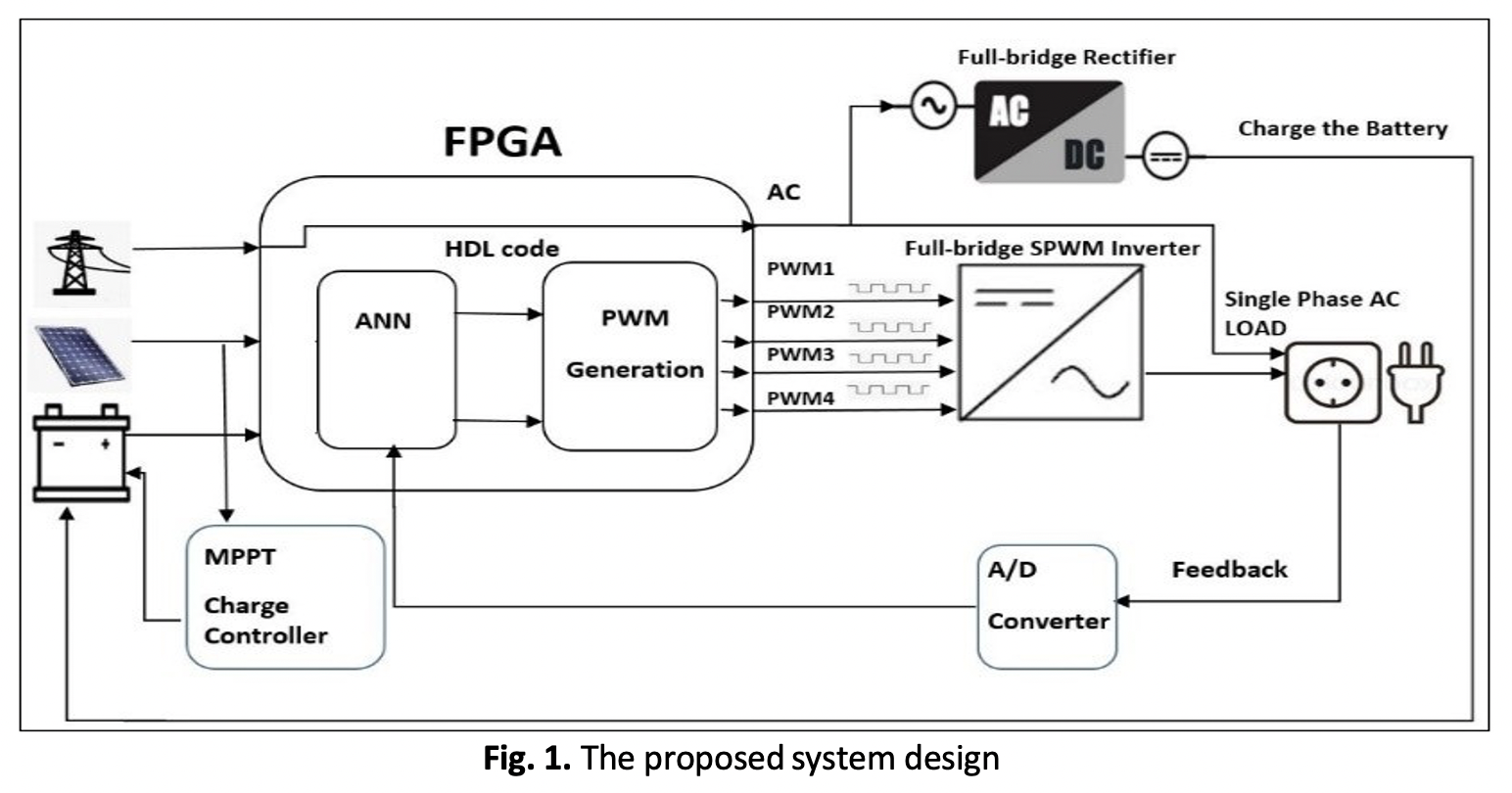
This paper presents the development and implementation of an intelligent hybrid solar inverter with feedback. The inverter converts the applied direct current (DC) from a photovoltaic (PV) array combined with an energy storage device (Battery) into pure sinusoidal alternating current (AC) at the specified output voltage of 220V and 50Hz frequency in conjunction with an AC power source (Grid) to supply sufficient power during a power outage. This work aims to construct a bipolar Sinusoidal Pulse Width Modulation (SPWM) employing a Field Programmable Gate Array (FPGA) for a single-phase full-bridge inverter with feedback to maintain the output power. In MATLAB, an Artificial Neural Network (ANN) is created and trained using the Levenberg-Marquardt (LM) algorithm to find the ideal configuration for the SPWM inverter's modulation index. The control method for the proposed inverter with feedback has been designed using MATLAB/SIMULINK and ISE Suite 14.7. The controller with ANN feedback was converted to HDL code and uploaded on the Xilinx Spartan 6 FPGA board. Simulation results have shown that the inverter’s efficiency at a full load increased to 91.95% and by adjusting the modulation index and switching frequency, the Total Harmonic Distortion (THD) of the sinusoidal output waveform can be minimized.