
Investigating the Effect of Adding Fe2O3 And SiC on the Mechanical, Electrical and Magnetic Properties of Aluminum Based Hybrid Nano Composites Employing Powder Metallurgy Technique

Authors

  • Ahmed Hussein Hleewass Electromechanical Engineering Department, University of Technology, Baghdad, Iraq
  • Khansaa Dawood Salman Retired of Electromechanical Engineering Department, University of Technology, Baghdad, Iraq
  • Ahmed Kamil Hasan Al-AlI Electromechanical Engineering Department, University of Technology, Baghdad, Iraq

DOI:

https://doi.org/10.37934/sej.11.1.192206

Keywords:

Powder metallurgy, hybrid Nano composites, aluminum matrix, magnetite Fe2O3, silicon carbide SiC, mechanical properties, electrical properties, magnetic properties

Abstract

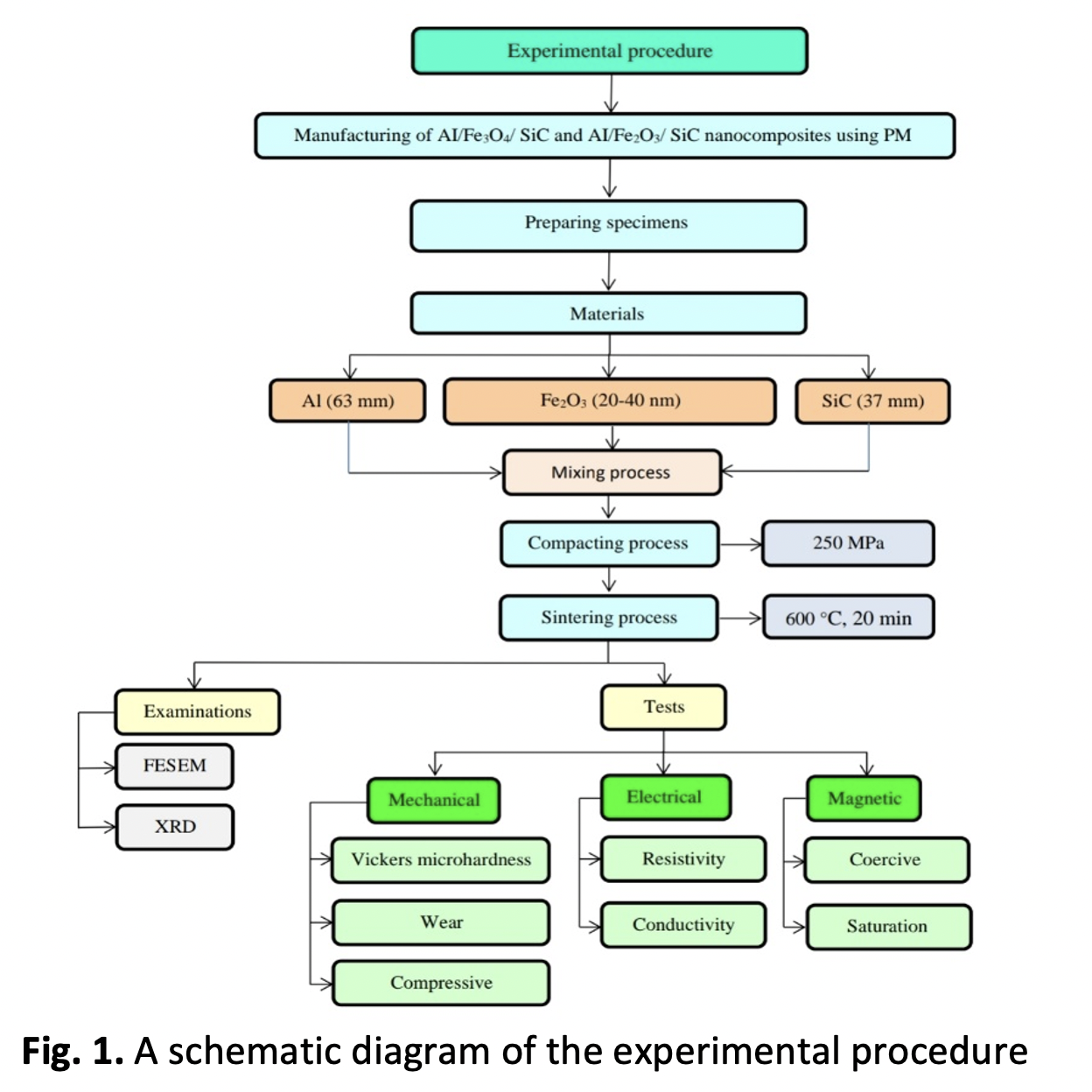
Fabrication of Al/Fe2O3+SiC hybrid nanocomposites using the powder metallurgy method is the focus of this study. Different concentrations of Fe2O3 (Hematite) (2, 4, 6, 8 and 10wt%) were incorporated into the materials at the same time as SiC (Silicon Carbide) was maintained at a consistent ratio of 5wt%. The synthesized specimens underwent comprehensive testing such as FESEM ( Field Emission Scanning Electron Microscopy) and XRD (X-Ray diffraction) for microstructural analysis; compressive strength, wear resistance and Vickers microhardness for mechanical properties assessment; and electrical conductivity, resistivity, and magnetic hysteresis for evaluation of electrical behavior. Microstructure examinations revealed that SiC and Fe2O3 nanoparticles were uniformly distributed throughout the aluminum matrix. In terms of mechanical tests done on this material, there were significant improvements in compressive strength amounting to a 195.20% increase, wear rate which went down by 78.72%, as well as an improvement in microhardness by 44.91% compared with pure aluminum. With the addition of 10wt.% Fe2O3, electrical resistivity increased by about 54% whereas conductivity dropped by almost 35.01%. On the other hand, hysteresis loop analysis showed an increase in saturation magnetization (Ms) as well as remanence magnetization (Mr), with increasing amounts of Fe2O3 in hybrid nanocomposite. This research signifies transformative progress that can be accomplished when SiC and Fe2O3 nanoparticles are strategically infused into aluminum. highlighting their potential for advanced material applications.

Author Biography

Ahmed Kamil Hasan Al-AlI, Electromechanical Engineering Department, University of Technology, Baghdad, Iraq

ahmed.k.alali@uotechnology.edu.iq

Downloads

Published

2025-12-25

Issue

Section

Articles