
Particle Size Distribution Emitted from Combustion of Diesel- Waste Cooking Oil Biodiesel Blends

Authors

  • Noora S. Ekab Elctromechanical Engineering Department, University of Technology- Iraq, Baghdad, Iraq
  • Miqdam T. Chaichan Energy and Renewable Energies Technology Center, University of Technology- Iraq, Baghdad 10001, Iraq
  • Ghassan A. Bilal Energy and Renewable Energies Technology Center, University of Technology- Iraq, Baghdad 10001, Iraq
  • Mohammed A. Fayad Energy and Renewable Energies Technology Center, University of Technology- Iraq, Baghdad 10001, Iraq
  • Ahmed H. Janabi Computer Techniques, College of Engineering & Technology, Al-Mustaqbal University |Babylon, Iraq
  • Hasan Ali Jebur Abo Dihin Computer Techniques, College of Engineering & Technology, Al-Mustaqbal University |Babylon, Iraq
  • Ali Al-Mahmood Computer Techniques, College of Engineering & Technology, Al-Mustaqbal University |Babylon, Iraq

DOI:

https://doi.org/10.37934/sej.11.1.178191

Keywords:

Total suspended particles, biodiesel, sulfur, PM1, PM2.5, PM10

Abstract

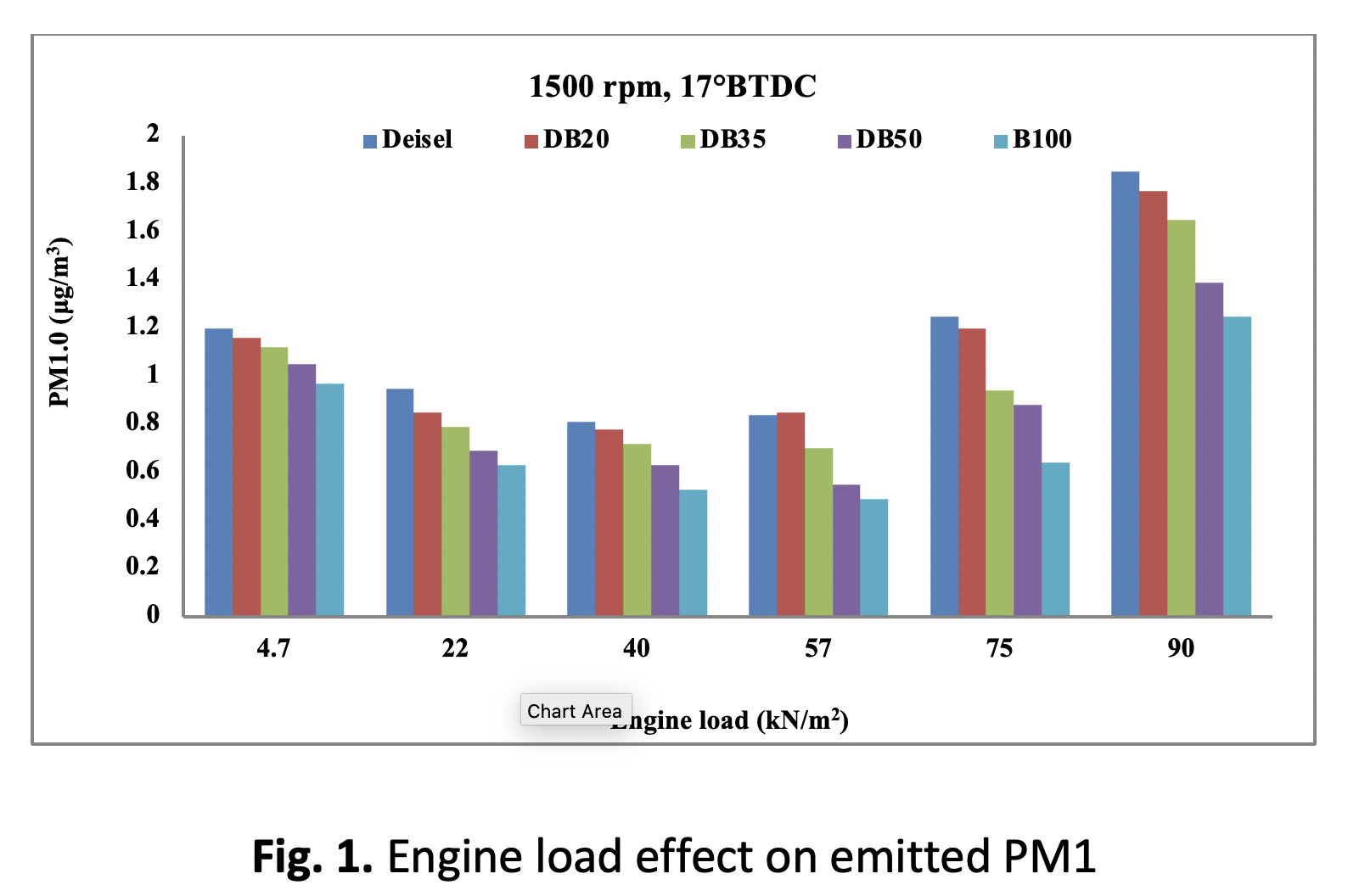
Iraqi diesel is characterized by its high sulfur content, which causes the emission of high concentrations of particulate matter. This work focuses on the evaluation of these particle size distribution when the engine is fuelled by pure diesel fuel blended with biodiesel. The study focused on particulates matters mass concentration. The first goal consists of monitoring the percentage of particulate matter substances emitted by the diesel engine powered with pure diesel fuel and biodiesel-diesel blends. The emissions of particles of all sizes decreased from biodiesel blends with a significant effect on particles measured in nano and fine particles. Under constant engine speed and variable load and, PM2.5 was reduced by 7.2%, 16.7%, 32.2% and 42.8% for DB20, DB35, DB50 and B100 compared to diesel, respectively. For the same testing conditions, the TSP reduced by 4.98%, 12.07%, 21.54% and 26.53%, respectively. The use of biodiesel blends also resulted in a significant reduction in particulate matter compared to diesel when the engine run at variable speed and fixed load. The reduction rate for PM1 was 12.13%, 36.65%, 60.92% and 81.06% for DB20, DB35, DB50 and B100, respectively. The PM10 reduced by 9%, 25.98%, 43% and 61.3%, respectively.

Author Biography

Noora S. Ekab, Elctromechanical Engineering Department, University of Technology- Iraq, Baghdad, Iraq

20112@uotechnology.edu.iq 

Downloads

Published

2025-12-25

Issue

Section

Articles