Traffic Scenario Evaluation of Joint MEC Server Placement and Routing in Urban and Rural Networks
DOI:
https://doi.org/10.37934/sej.17.1.133149Keywords:
Mobile Edge Computing, ILP, server placement, routing, latencyAbstract
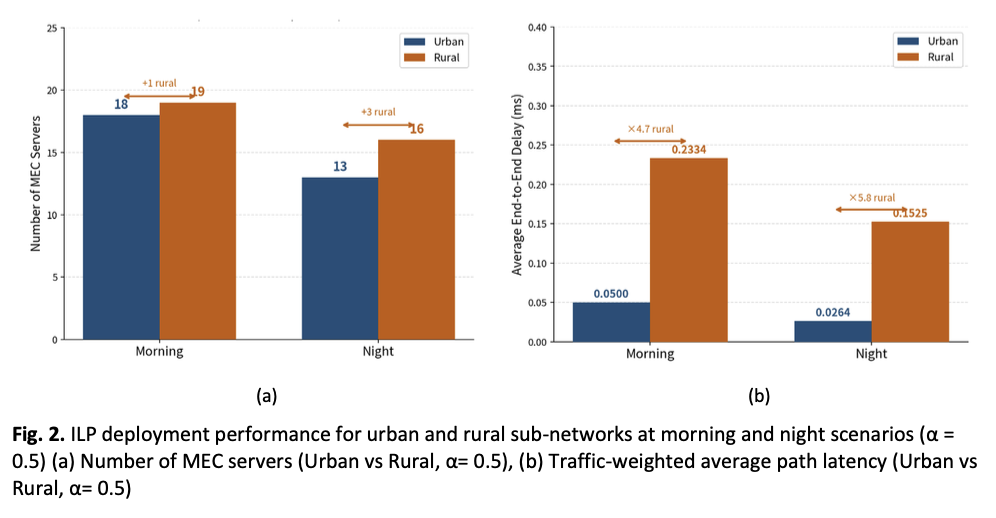
Multiaccess Edge Computing (MEC) reduces the latency of modern applications by deploying edge servers close to the users, at the base stations (BSs). However, the placement of a limited number of MEC servers is a challenging problem that strongly depends on the traffic demand, which varies over the time of the day and across the deployment environment. In this paper, we formulate the joint MEC server placement and traffic routing problem as an Integer Linear Programming (ILP) model that minimizes a weighted combination of the number of activated servers and the trafficweighted average delay, subject to server-capacity, link-capacity, and end-to-endlatency constraints. The model is evaluated on a real dataset of 554,383 sessions from the Shanghai Telecom network, using a dense urban and a sparse rural sub-network of 50 BSs each. The results reveal a constraint regime shift between the two environments: the urban placement is dominated by the server capacity, whereas the rural placement is dominated by the end-to-end latency, which leads to rural delays that are 4.7–5.8× higher than the urban ones. A cross-scenario robustness analysis shows that a static single-scenario placement either overflows the capacity at the peak (up to 248% server utilization) or wastes resources during the off-peak periods. To address this, an aggregated deployment strategy is proposed, in which a single placement is dimensioned on an aggregated demand; it remains feasible across all the traffic periods while avoiding the overflow and reducing the waste of the single scenario designs.