Development and Validation of an AI-Based Decision Support Framework for Optimizing Financial Assistance Allocation in Higher Education
DOI:
https://doi.org/10.37934/sej.17.1.1735Keywords:
AI-Based, XGBoost, Multilayer Perceptron (MLP), AI-based intervention, student wellbeing, mental health disorder, higher education systemAbstract
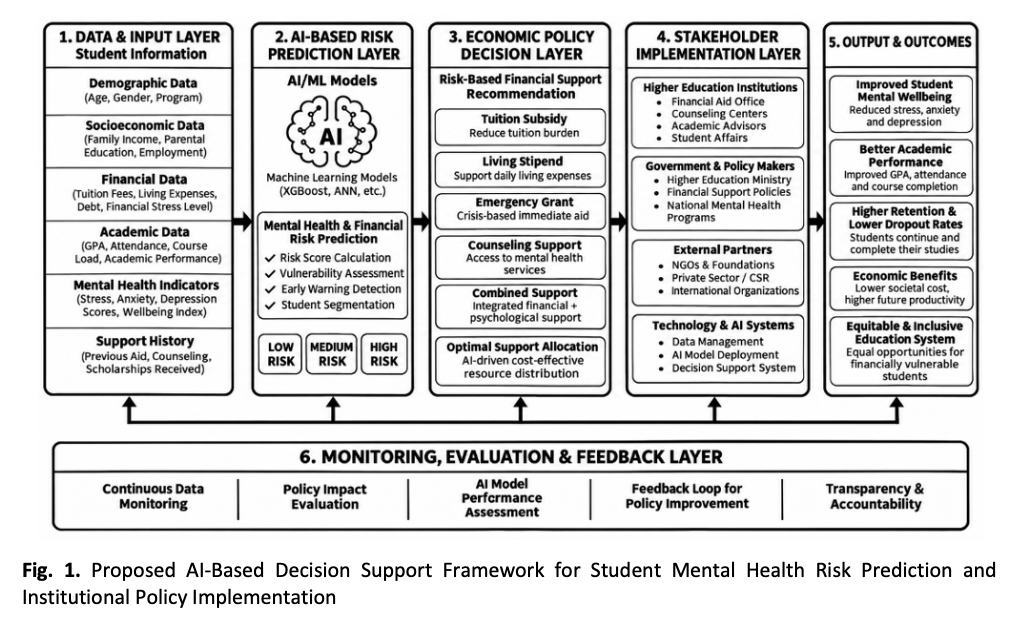
This paper presents an artificial intelligence (AI)-based decision support framework for optimising financial assistance allocation in higher education institutions, with the aim of improving student mental health and well-being. A dataset comprising 5,000 students from various academic programmes was developed, with approximately 15% of the students identified as financially vulnerable and at risk of mental health disorders. Two AI-based models, namely Extreme Gradient Boosting (XGBoost) and Multilayer Perceptron (MLP), were employed for predictive analysis and financial assistance estimation. The results demonstrated that XGBoost outperformed MLP in predictive accuracy, achieving an accuracy of 94.8% and a receiver operating characteristic area under the curve (ROC-AUC) of 0.96, while MLP demonstrated a greater capacity to capture complex nonlinear relationships. The proposed framework estimated an annual institutional financial assistance expenditure of approximately USD 1.06 million, corresponding to an average allocation of USD 1,417 per supported student. The findings highlight the potential importance of targeted financial assistance, including tuition fee subsidies, living allowances, and emergency grants, alongside counselling services, in supporting student well-being, academic continuity, and retention. Overall, the proposed AI-based framework provides a datadriven approach that integrates mental health risk assessment with financial aid decision-making, offering higher education institutions a systematic mechanism for identifying vulnerable students and prioritising financial assistance according to their needs.