Finite Element-Based Structural Optimization and Safety Evaluation of an Eddy-Current Chassis Dynamometer for Motorcycles up to 200 cc
DOI:
https://doi.org/10.37934/sej.17.1.3661Keywords:
Eddy-current chassis dynamometer, motorcycles up to 200 c, finite element analysis, structural improvement, factor of safety (FoS), design evaluationAbstract
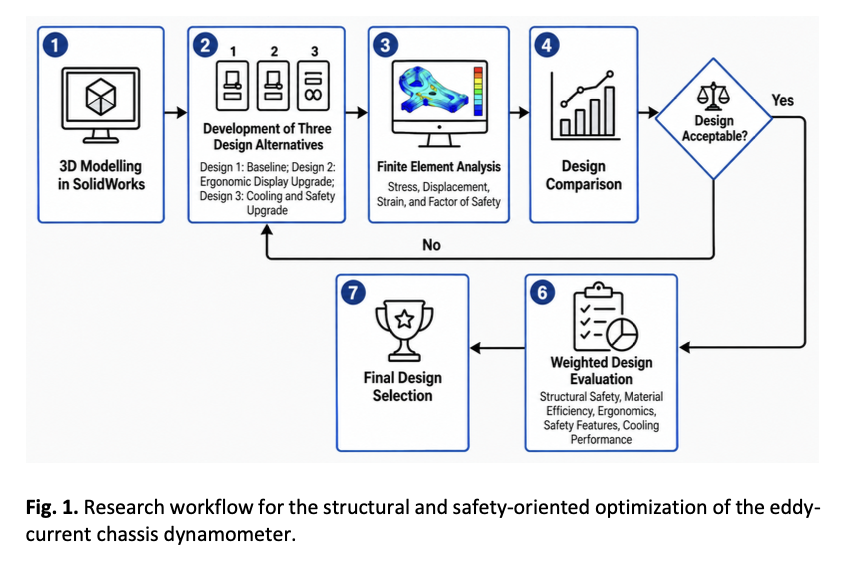
Motorcycle chassis dynamometers are tools for evaluating engine performance under workshop conditions. For motorcycles up to 200 cc, compact dynamometer structures must provide structural integrity while remaining material-efficient, manufacturable, and safe for workshop operation. This study presents a preliminary structural and safety-oriented evaluation of an eddy-current chassis dynamometer for motorcycles up to 200 cc. Three configurations with structural thicknesses of 6.0, 5.5, and 5.0 mm were modelled in SolidWorks and analysed using static finite element analysis under a uniformly distributed vertical load of 1400 N. Plain carbon steel, with a yield strength of 220.6 MPa, was selected based on availability, weldability, and suitability for fabrication. Structural performance was evaluated using von Mises stress, resultant displacement, equivalent strain, and factor of safety (FoS), while material efficiency and operational safety readiness were incorporated into a weighted multi-criteria design-selection framework. All configurations produced maximum stresses below the yield strength and minimum FoS values ranging from 2.3 to 4.2, exceeding the preliminary screening criterion of 2.0. Design 1 exhibited the lowest maximum von Mises stress of 52.80 MPa and highest FoS of 4.2. Design 2 showed a balanced response, with a maximum stress of 56.17 MPa, displacement of 0.862 mm, FoS of 3.9, and an 8.33% thickness reduction relative to the baseline. Design 3 achieved the greatest thickness reduction of 16.67% but recorded the highest stress of 96.33 MPa, displacement of 1.172 mm, and lowest FoS of 2.3. Nevertheless, Design 3 achieved the highest weighted score of 4.20 and was identified as the preferred preliminary configuration. The findings represent comparative static design screening rather than operational validation; dynamic and fatigue analyses, prototype fabrication, and experimental testing under representative operating conditions are required before practical implementation.