
Human Factors and Safety Communication in Engineering Safety Performance: A Predictive PLS-SEM Model for Petrochemical Operations

Authors

  • Mishar Minhat Faculty of Artificial Intelligence, Universiti Teknologi Malaysia, Kuala Lumpur, Malaysia
  • Sa’ardin Abdul Aziz Faculty of Artificial Intelligence, Universiti Teknologi Malaysia, Kuala Lumpur, Malaysia
  • Mohamed Azlan Suhot Faculty of Artificial Intelligence, Universiti Teknologi Malaysia, Kuala Lumpur, Malaysia
  • Roslina Mohammad Faculty of Artificial Intelligence, Universiti Teknologi Malaysia, Kuala Lumpur, Malaysia
  • Faizir Ramlie Faculty of Artificial Intelligence, Universiti Teknologi Malaysia, Kuala Lumpur, Malaysia
  • Mohd Shamsuri Khalid Faculty of Artificial Intelligence, Universiti Teknologi Malaysia, Kuala Lumpur, Malaysia
  • Wan Rosanisah Wan Mohammad Faculty of Artificial Intelligence, Universiti Teknologi Malaysia, Kuala Lumpur, Malaysia
  • Mas Omar Mas Rosemal Hakim Faculty of Artificial Intelligence, Universiti Teknologi Malaysia, Kuala Lumpur, Malaysia
  • Naz Khanaz Abdul Rahman PETRONAS, Bintulu Additional Gas Sales Facilities 2 (BAGSF-2) Project Development, Tanjung Kidurong, Bintulu, Sarawak, Malaysia

DOI:

https://doi.org/10.37934/sej.16.1.130148

Keywords:

Engineering Safety, Human Factors, Safety Communication, Safety Performance, Petrochemical Operations, PLS-SEM

Abstract

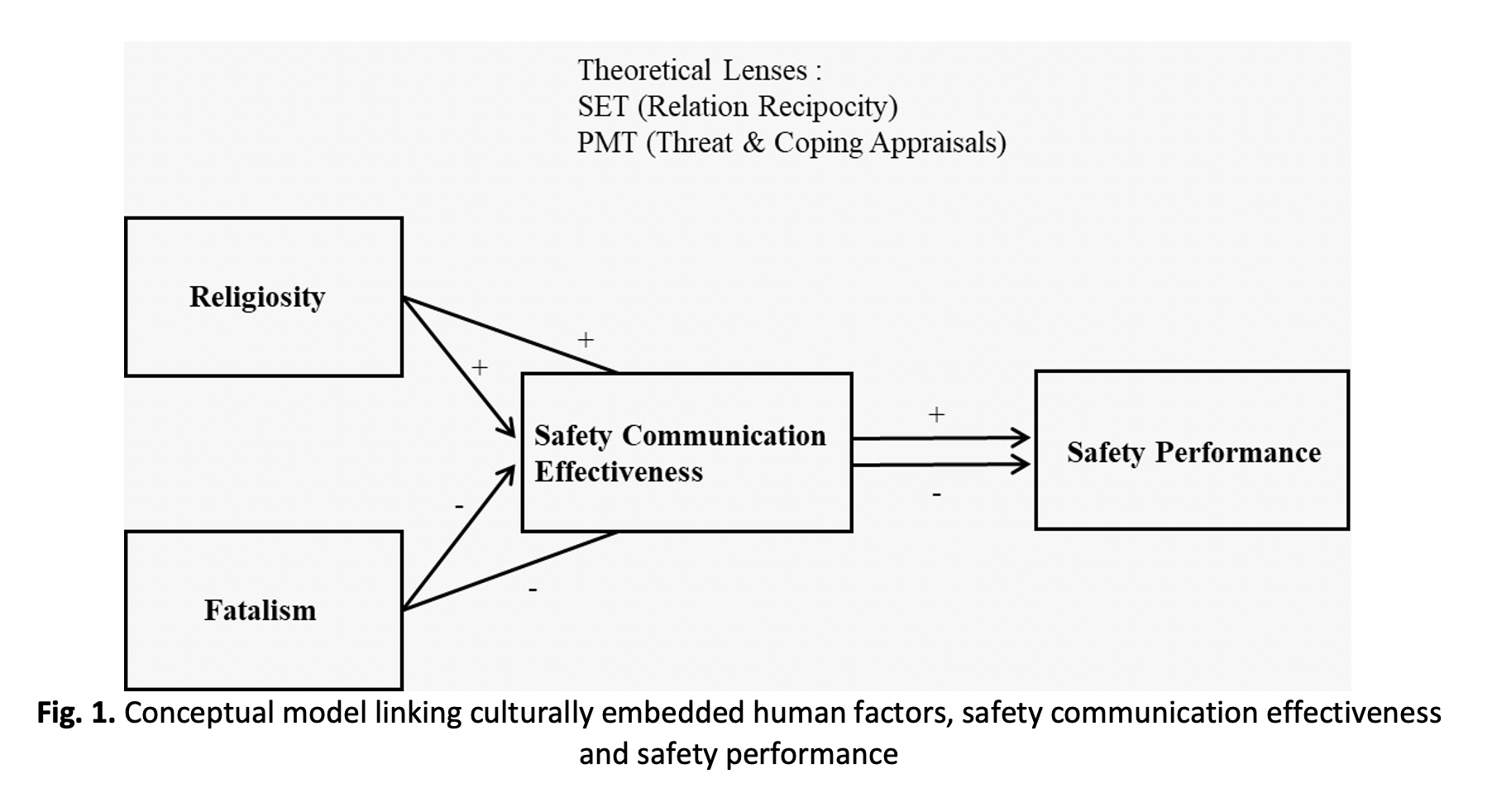
Petrochemical operations are complex engineering systems in which safety performance depends not only on technical safeguards and process controls but also on human and organisational factors that influence how workers perceive, interpret, and respond to safety requirements. Despite advances in engineering controls and occupational safety management systems, incidents continue to occur, highlighting the need to integrate human factors into engineering safety management. This study develops and evaluates a predictive model of engineering safety performance by examining the effects of two culturally embedded human factors, religiosity and fatalism, together with safety communication effectiveness in Malaysian petrochemical operations. A quantitative cross-sectional survey was conducted involving 463 employees and contractors from major petrochemical facilities in Malaysia. Data were analysed using Partial Least Squares Structural Equation Modelling (PLS-SEM). The measurement model demonstrated satisfactory reliability and validity. The structural model showed that religiosity significantly influenced safety communication effectiveness (β = 0.442, p < 0.001) and safety performance (β = 0.436, p < 0.001), while fatalism significantly influenced safety communication effectiveness (β = 0.451, p < 0.001) and safety performance (β = 0.378, p < 0.001). In contrast, safety communication effectiveness did not directly predict safety performance (β = −0.006, p = 0.954). The model explained 74.7% of the variance in safety communication effectiveness and 61.2% of the variance in safety performance. These findings demonstrate that engineering safety performance in high-risk petrochemical operations cannot be addressed solely through technical controls and communication systems. Integrating culturally embedded human factors with organisational safety mechanisms provides a more comprehensive approach to engineering safety management and supports the development of human-centred safety interventions for complex industrial operations.

Author Biographies

Mishar Minhat, Faculty of Artificial Intelligence, Universiti Teknologi Malaysia, Kuala Lumpur, Malaysia

mish.minhat@yahoo.com

Sa’ardin Abdul Aziz, Faculty of Artificial Intelligence, Universiti Teknologi Malaysia, Kuala Lumpur, Malaysia

saa.kl@utm.my

Mohamed Azlan Suhot, Faculty of Artificial Intelligence, Universiti Teknologi Malaysia, Kuala Lumpur, Malaysia

azlans.kl@utm.my

Roslina Mohammad, Faculty of Artificial Intelligence, Universiti Teknologi Malaysia, Kuala Lumpur, Malaysia

mroslina.kl@utm.my

Faizir Ramlie, Faculty of Artificial Intelligence, Universiti Teknologi Malaysia, Kuala Lumpur, Malaysia

faizir.kl@utm.my

Mohd Shamsuri Khalid, Faculty of Artificial Intelligence, Universiti Teknologi Malaysia, Kuala Lumpur, Malaysia

m.shamsuri@utm.my

Wan Rosanisah Wan Mohammad, Faculty of Artificial Intelligence, Universiti Teknologi Malaysia, Kuala Lumpur, Malaysia

wanrosanisah@utm.my

Mas Omar Mas Rosemal Hakim, Faculty of Artificial Intelligence, Universiti Teknologi Malaysia, Kuala Lumpur, Malaysia

mas.omar@utm.my

Naz Khanaz Abdul Rahman, PETRONAS, Bintulu Additional Gas Sales Facilities 2 (BAGSF-2) Project Development, Tanjung Kidurong, Bintulu, Sarawak, Malaysia

naz.hses@gmail.com

Downloads

Published

2026-10-05

Issue

Section

Articles