

From Photosynthetic Quantum Energy Transfer to Verifiable Bio-inspired Energy Devices

Authors

  • Hadi Suwono Department of Biology, Faculty of Mathematics and Natural Sciences, State University of Malang, 65145 Malang, Indonesia
  • Marsya Aulia Rizkita Marketing Management, Faculty of Vocational Studies, State University of Malang, 65145 Malang, Indonesia
  • Chun-Yen Chang Department of Earth Sciences, National Taiwan Normal University, 88, Section 4, Ting-Jou Rd., Taipei City, 116, Taiwan

DOI:

https://doi.org/10.37934/sej.16.1.149171

Keywords:

Quantum Biology, Photosynthetic Energy Transfer, Bio-inspired Photovoltaics, Energy Conversion, Measurement and Verification

Abstract

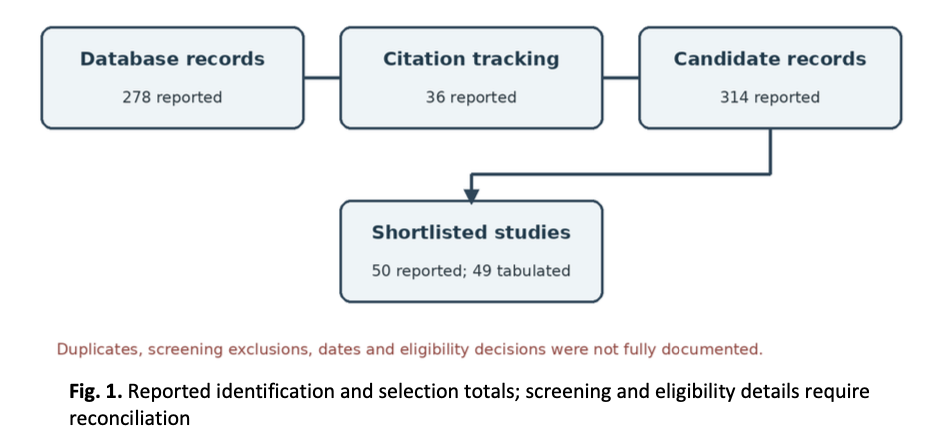
Photosynthetic pigment–protein complexes suggest design principles for light harvesting, but quantum coherence or strong coupling alone does not establish improved electrical output in an engineered device. This review reframes quantum biology as an energy engineering problem: which molecular energy-transfer mechanisms can be translated into a reproducible photonic architecture and tested against a matched control? The source search reported 314 candidate records and 50 shortlisted studies, of which 49 were tabulated, 48 were unique, and 44 fell within the 2018–2024 window. No common device-output endpoint exists, so the evidence is synthesized descriptively without pooled effects. The study contributes a design specification rather than a fabricated prototype or validated model: a pigment-based absorber in an optical microcavity, an otherwise identical control with the cavity detuned or omitted, and acceptance gates based on external quantum efficiency (EQE), power conversion efficiency (PCE) and aging. A planning calculation shows that five devices per arm resolve a relative power difference of about 10% only when device scatter is near or below 5%. These are design criteria, not measured gains, and no efficiency improvement or emissions saving can be inferred. The framework gives engineers testable gates for prototype decisions.

Author Biographies

Hadi Suwono, Department of Biology, Faculty of Mathematics and Natural Sciences, State University of Malang, 65145 Malang, Indonesia

hadi.suwono.fmipa@um.ac.id

Marsya Aulia Rizkita, Marketing Management, Faculty of Vocational Studies, State University of Malang, 65145 Malang, Indonesia

marsyaauliarr.fv@um.ac.id

Chun-Yen Chang, Department of Earth Sciences, National Taiwan Normal University, 88, Section 4, Ting-Jou Rd., Taipei City, 116, Taiwan

changcy@ntnu.edu.tw

Downloads

Published

2026-10-27

Issue

Section

Articles